What Are Over-Door Heating Systems? How Heated Air Curtains Work
Over-door heating systems are used in commercial buildings to support thermal comfort around entrances exposed to changing outdoor conditions. They are particularly relevant to hotels, shopping centres, offices and retail premises where frequent door openings can create uncomfortable draughts and temperature fluctuations.
One of the most common solutions is the heated air curtain, which combines a directed airflow with an optional heating function.
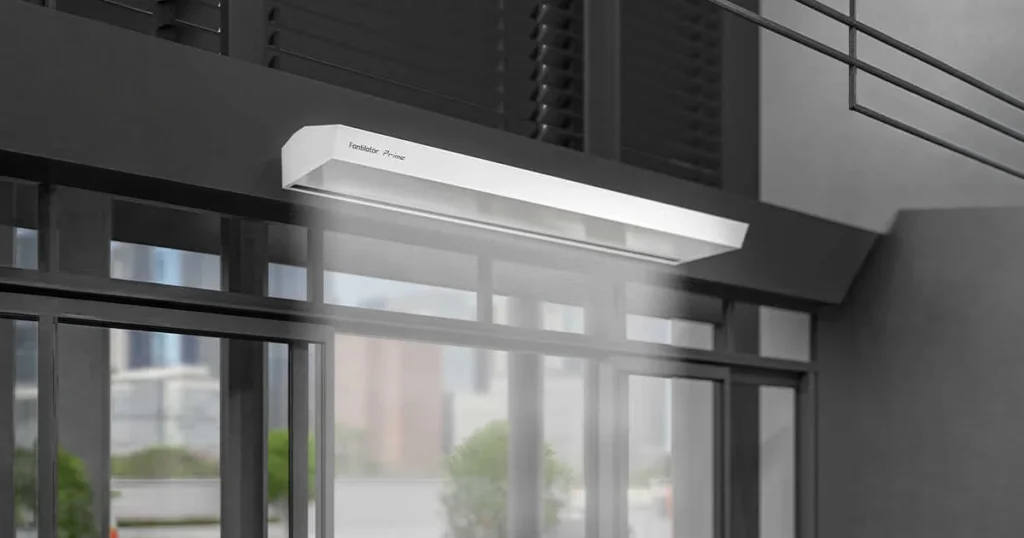
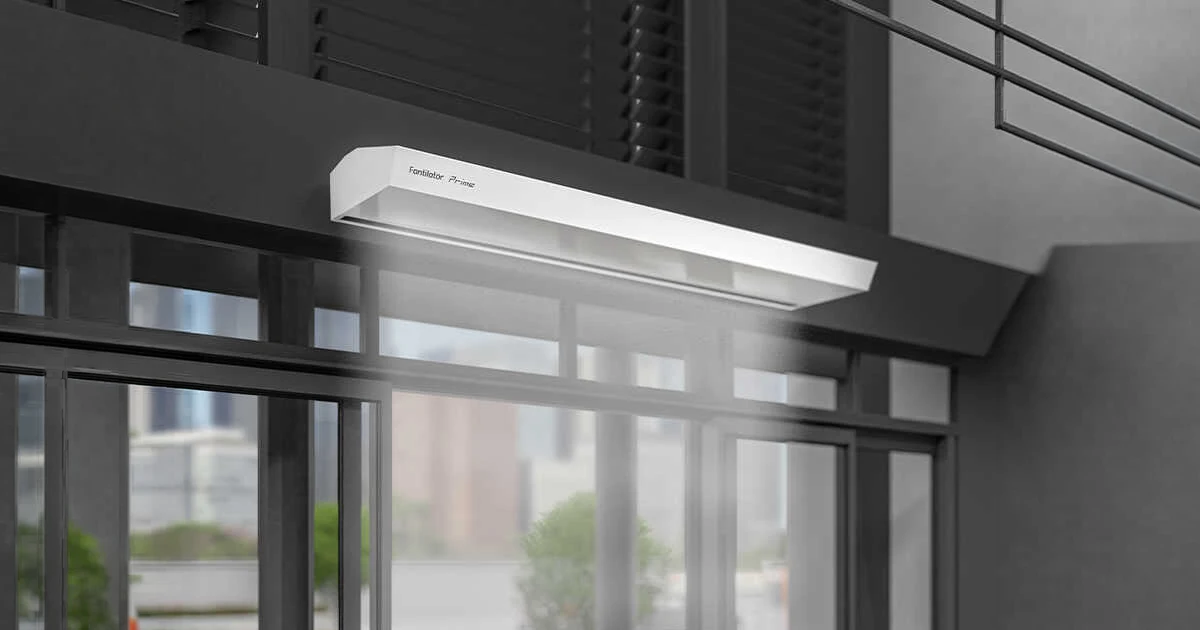
Unlike an ordinary fan heater, a heated air curtain is designed to project an air stream across a doorway. This airflow helps reduce unwanted air exchange between the indoor and outdoor environments, while the heating element can provide additional warmth near the entrance.
However, not all over-door heating systems use the same technology. Electric resistance air curtains and hot-water coil systems differ in their energy requirements, installation arrangements and operating costs.
Understanding these differences is essential when specifying equipment for a commercial entrance.
What Are Over-Door Heating Systems?
Over-door heating systems are devices installed above or near entrances to improve local thermal comfort.
The term can describe several types of equipment, but heated air curtains have a particular operating purpose.
They use fans and an appropriately designed discharge outlet to project airflow across an opening. The heating function then warms this airflow when required.
The air stream can help reduce the movement of unconditioned outdoor air into a building and limit the escape of conditioned indoor air.
This is different from simply blowing warm air into an entrance lobby.
An ordinary heater may provide local warmth without creating an effective air separation pattern across the doorway.
Heated air curtains are generally supplementary entrance systems rather than substitutes for a building’s primary heating, cooling or ventilation equipment.
How Do Heated Air Curtains Work?
A heated air curtain combines three main processes: air intake, optional heating and controlled discharge.
During operation, fans draw air into the unit. Depending on the model, the airflow may pass through electric heating elements or a water-fed heat exchanger.
The air is then discharged through an outlet designed to direct the stream across the doorway.
In horizontal installations above a commercial entrance, the airflow is generally directed downwards.
Consider a hotel lobby during winter. Frequent pedestrian movement can expose the reception area to cold outdoor air.
A properly selected heated air curtain can help manage this air movement while providing warmed airflow around the entrance.
However, heating the air does not automatically make the air barrier more effective.
Air curtain performance depends on discharge velocity, airflow distribution, mounting position and the pressure conditions around the opening.
Heating and air separation should therefore be treated as related but distinct functions.
What Is an Electric Heated Air Curtain?
An electric heated air curtain uses electric resistance elements to warm the airflow.
The fans create the air stream, while the heating elements add thermal energy when heating is required.
Depending on the controller, the system may offer different fan speeds and heating stages.
Electric heated air curtains can be considered where suitable electrical infrastructure is available, particularly in buildings without a convenient central hot-water connection.
Their suitability depends on more than equipment size.
The available electrical supply, required heating capacity, operating hours and installation conditions must all be assessed.
Electric Heating Stages
Some commercial heated air curtains provide multiple heating stages.
This allows their thermal output to be adjusted according to operating conditions rather than requiring continuous operation at maximum output.
Adezza’s Air Curtain product range includes the Niva Life commercial electric heated series.
Its published technical data lists heating stages of 4, 8 and 11 kW for the KLC-H100 model, and 8, 18 and 28 kW for the KLC-H250.
These are model-specific thermal output options, not universal requirements for commercial entrances.
Higher heating capacity should only be selected where the building and operating conditions justify it.
What Is a Hot-Water Heated Air Curtain?
A hot-water heated air curtain uses a heat exchanger supplied by a central hot-water system.
Fans move air across the coil, where heat is transferred from the circulating water to the airflow.
The warmed air is then discharged towards the entrance opening.
This type of system can be suitable for buildings that already have an appropriate hot-water heating network.
Unlike an electric resistance air curtain, the main heating energy is generated elsewhere in the building’s mechanical system.
The air curtain still requires electrical power for fans and controls, and its total operating cost also depends on how the hot water is produced.
Pipe connections, control valves, flow rates and maintenance access must be included in the installation design.
How Does Water Temperature Affect Heating Capacity?
The thermal output of a hot-water coil depends on the temperature and flow conditions of the circulating water.
Adezza’s Niva Vito water coil air curtain specifications include heating-capacity figures based on published operating conditions, including a 90°C water inlet temperature and a 15°C air inlet temperature.
These figures should not be interpreted as guaranteed output at every building’s operating temperatures.
For example, a project using a lower-temperature heating network may achieve a different output from the listed rating condition.
The design team should therefore confirm performance using the actual supply temperatures, water flow and selected equipment.
Electric vs Hot-Water Heated Air Curtains
Electric and hot-water air curtains can provide similar entrance functions, but their heating arrangements are different.
| Feature | Electric Heated Air Curtain | Hot-Water Heated Air Curtain |
|---|---|---|
| Heating source | Electric resistance elements | Water-fed heat exchanger |
| Required services | Suitable electrical supply | Electrical supply and hot-water pipework |
| Thermal control | Heating stages and compatible controls | Water temperature, valves and compatible controls |
| Installation considerations | Electrical load and mounting | Pipework, controls, mounting and servicing |
| Operating costs | Electricity rates and duty cycle | Central heat generation and operating conditions |
| Adezza example | Niva Life | Niva Vito |
Neither system is automatically the most economical choice in every application.
An electric solution may be practical where the necessary electrical capacity is available and no hot-water distribution system exists.
A hot-water coil system may be appropriate where the building already has an efficient central heating network.
A meaningful comparison should include purchase price, installation cost, maintenance and the full cost of supplying heat during operation.
Heated Air Curtain vs Conventional Over-Door Heater
An important distinction exists between a heated air curtain and a conventional over-door fan heater.
Both can discharge warm air, but their intended airflow patterns are different.
A fan heater is primarily designed to raise or maintain the local air temperature.
A heated air curtain is designed to produce a directed air stream capable of covering a doorway and reducing unwanted air exchange.
The heating function provides an additional comfort benefit.
For this reason, the heating capacity of a unit should not be used as the sole measure of its suitability as an air curtain.
A high-output heater may warm the entrance area without creating an effective air stream across the opening.
The project specification should establish whether the primary requirement is local heating, air separation or both.
How to Select the Heating Capacity of an Air Curtain
Heating capacity is only one aspect of the selection process.
The first step is to understand the doorway and its operating conditions.
Door width, mounting height, pedestrian frequency and the exposure of the façade all affect the required air curtain arrangement.
Once the equipment can provide suitable airflow coverage, its heating output can be assessed against the building’s comfort requirements.
Heating Output Is Not the Same as Fan Motor Power
Commercial air curtain specifications may list motor power and thermal capacity separately.
For example, the published Niva Life KLC-H100 specifications identify a fan motor power of 370 W and selectable heating outputs of 4, 8 and 11 kW.
The motor power describes the electrical demand associated with the fan drive.
The heating output describes the thermal energy provided by the heating elements.
For an electric resistance model, electrical supply design must account for the heating elements as well as the fans and controls.
Evaluating electrical demand from fan motor power alone would be misleading.
Door Height and Airflow Performance
A heated air curtain must be capable of delivering a suitable airflow over the required distance.
Adezza’s published technical data includes a 3,500 mm door-height figure for the Niva Life series and a 3,000 mm figure for the Niva Vito series.
These are specifications associated with particular product families, not universal mounting-height limits.
A project must also consider doorway width, wind exposure, building pressure and the positioning of the discharge outlet.
For a broader explanation of air curtain dimensions and entrance selection, see Adezza’s general air curtain guide.
Do Heated Air Curtains Use a Lot of Energy?
Energy consumption depends on the heating technology and operating schedule.
For electric resistance models, the selected heating stage and operating duration can have a substantial effect on electricity consumption.
For water-heated models, the fan electricity and the energy used by the central hot-water system should both be considered.
A water-heated air curtain should not be described as having negligible energy costs simply because its electrical motor rating is relatively low.
Similarly, an electric model should not be assumed to operate at maximum heating output continuously.
Actual consumption depends on temperature controls, door usage and the operating strategy.
A properly specified air curtain may help reduce heating or cooling demand associated with uncontrolled air exchange.
However, the energy used by the air curtain itself must be included when evaluating the net benefit.
No single energy-saving percentage can be assumed for every installation.
Thermostats and Automatic Controls for Heated Air Curtains
A suitable control strategy can help avoid unnecessary heating.
Depending on the equipment, available functions may include temperature-based heating control, adjustable fan speeds, multiple heating stages and operating schedules.
Some systems can also be designed to respond to compatible door contacts or building control signals.
For example, a commercial entrance with concentrated visitor traffic may benefit from different operating settings during peak and quieter periods.
However, control compatibility must be confirmed for the actual product.
Not every heated air curtain offers the same thermostat, door-switch or building management interface options.
Electric heating systems also require appropriate over-temperature protection and electrical safety arrangements.
These functions should be verified through the manufacturer and project electrical design.
Where Are Over-Door Heating Systems Used?
Hotels and Hospitality Entrances
Hotel entrances can experience frequent opening cycles and substantial variations in visitor traffic.
Reception desks and seating areas near the entrance may be particularly sensitive to cold draughts.
A heated air curtain can be considered as part of the entrance comfort strategy, provided its airflow and heating capacity are suited to the opening.
Shopping Centres and Retail Stores
Retail entrances often experience prolonged periods of high pedestrian movement.
In these environments, the effectiveness of the air stream should be established before selecting the heating capacity.
An oversized heating element cannot compensate for inadequate doorway coverage or unsuitable mounting conditions.
Office Buildings
Office lobbies may require careful control of local temperatures around reception and waiting areas.
Operating schedules, compatibility with existing building systems and maintenance access can influence equipment selection.
Healthcare and Public Buildings
Healthcare and public entrances may have additional ventilation, accessibility and environmental requirements.
A heated air curtain should be assessed within the building’s overall mechanical design.
It should not be treated as an infection-control device or a substitute for specialist ventilation equipment.
Can Heated Air Curtains Be Used with Revolving Doors?
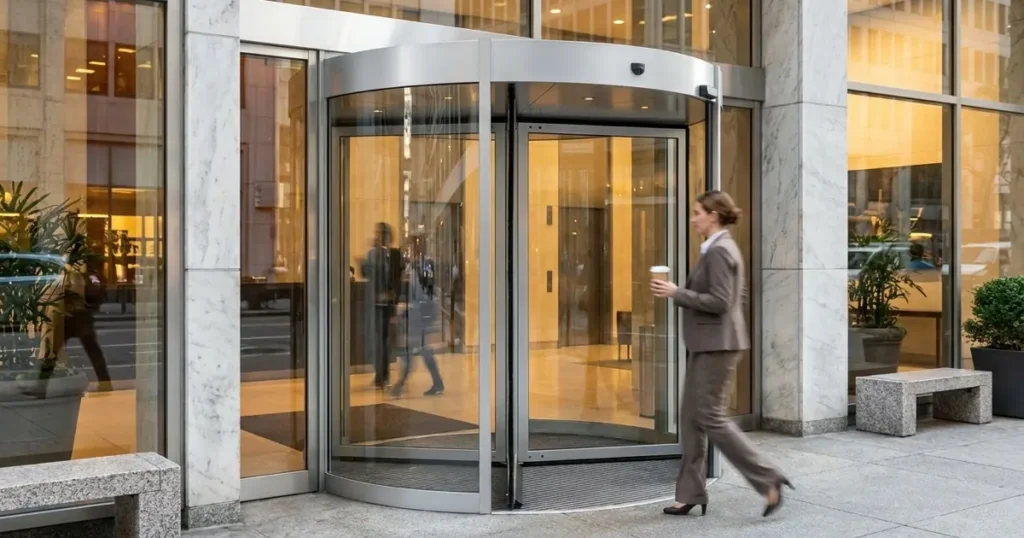
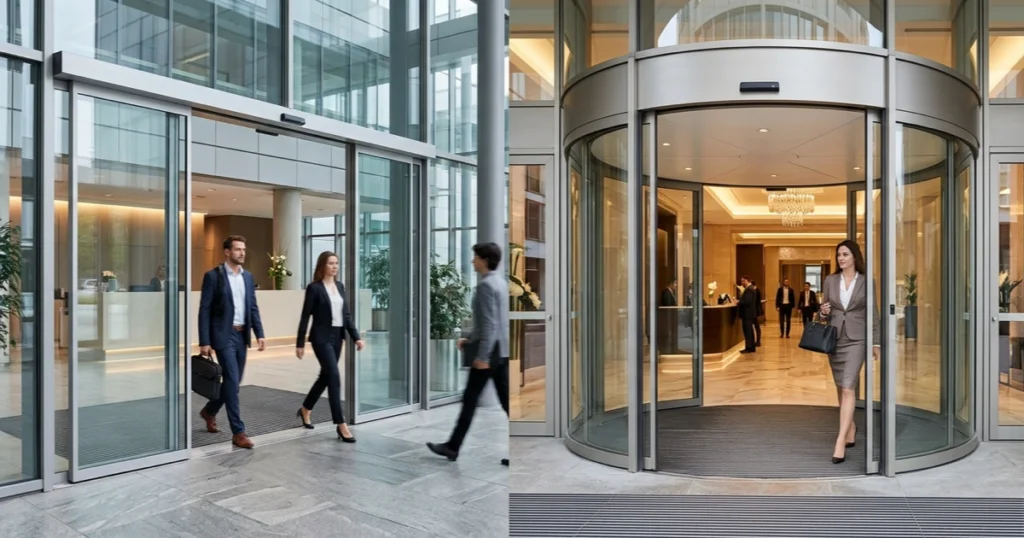
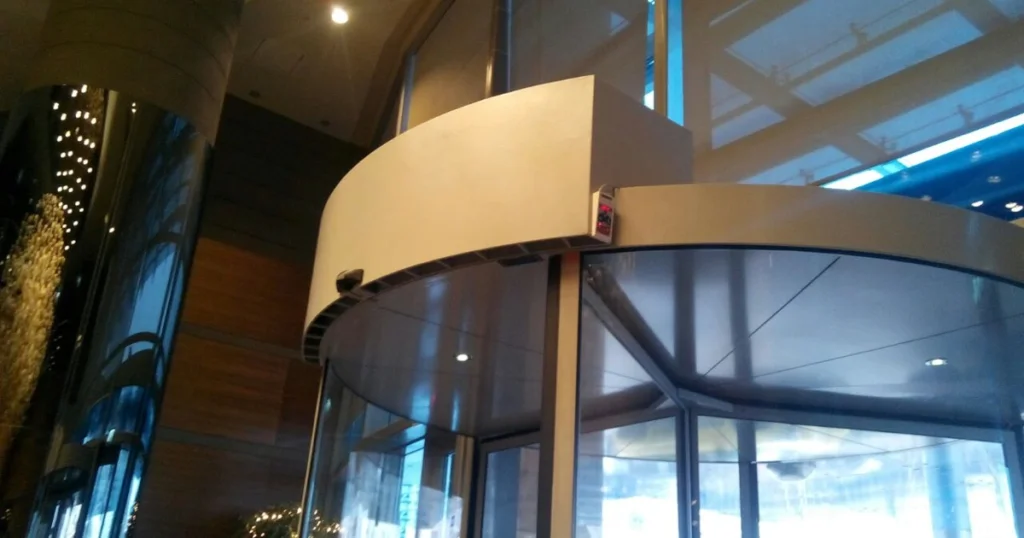
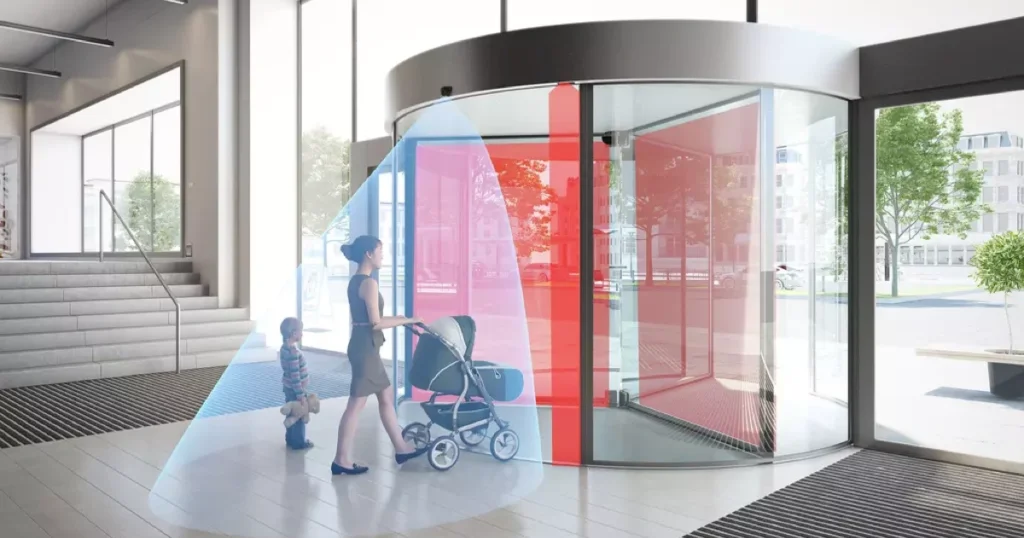
Heated air curtains can be evaluated alongside revolving doors where the mechanical and architectural arrangement allows an appropriate installation.
Revolving doors create moving compartments that help limit a continuously open connection between indoor and outdoor environments.
An air curtain provides a separate function by generating directed airflow in a selected entrance area.
The two solutions may complement one another, but their integration requires coordination.
The air curtain must not interfere with the revolving door’s moving components, safety sensors, canopy arrangement or pedestrian passage.
Electrical and, where applicable, hot-water connections must also be accommodated.
Not every revolving door requires a heated air curtain.
The decision should be based on entrance exposure, climate, building pressure and the comfort requirements of the occupants.
For more information, read Revolving Door Air Curtain: 6 Key Selection Criteria.
Installation and Maintenance Requirements
Heated air curtains require suitable mounting and services arrangements.
The structure supporting the unit must accommodate its weight, while the intake and discharge areas should remain unobstructed.
Electric models need appropriately designed electrical connections and protective devices.
Water-heated models also require pipework connections, suitable controls and access for servicing the coil.
Routine maintenance may include checking fan operation, cleaning air passages, inspecting electrical components and verifying heating controls.
For water coil systems, the condition of the hydraulic connections and associated mechanical equipment should also be reviewed.
Maintenance procedures should follow the manufacturer’s instructions and be performed by appropriately qualified personnel.
Over-temperature protection and other safety arrangements must not be bypassed.
Heated Air Curtain Solutions from Adezza
Adezza provides electric resistance and water coil air curtain options for commercial entrance applications.
The Niva Life electric heated range offers different unit lengths and heating stages.
The Niva Vito water coil range can be considered for projects with compatible central hot-water services.
Their published specifications include thermal output, airflow, fan power, installation dimensions and door-height information.
The right selection depends on how these characteristics match the building’s entrance conditions and mechanical infrastructure.
An effective over-door heating system is not simply the product with the highest heating capacity. It is the arrangement that delivers suitable airflow performance and an appropriate level of thermal comfort for the intended application.
Explore Adezza’s Air Curtain Systems or request a quotation by sharing your doorway dimensions, available services and building requirements.