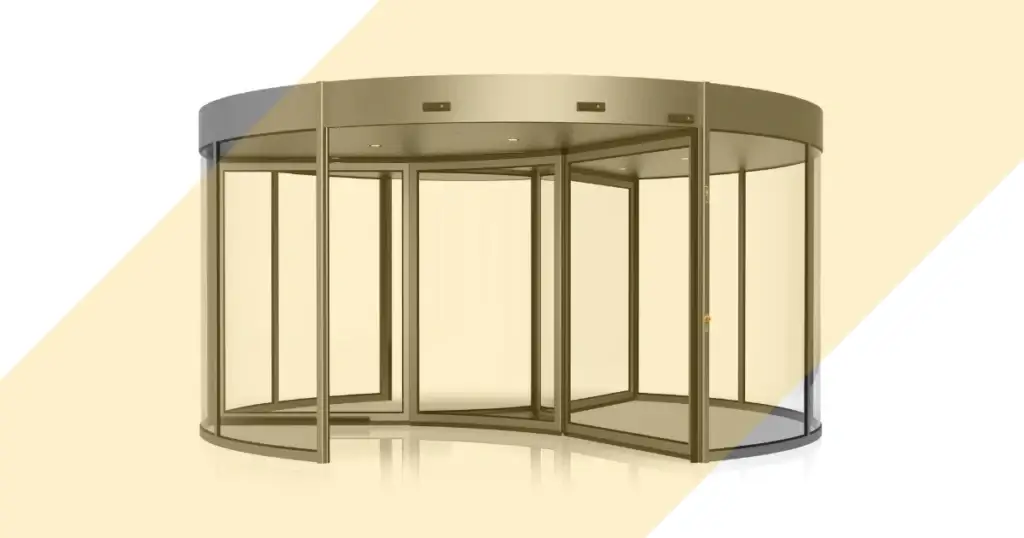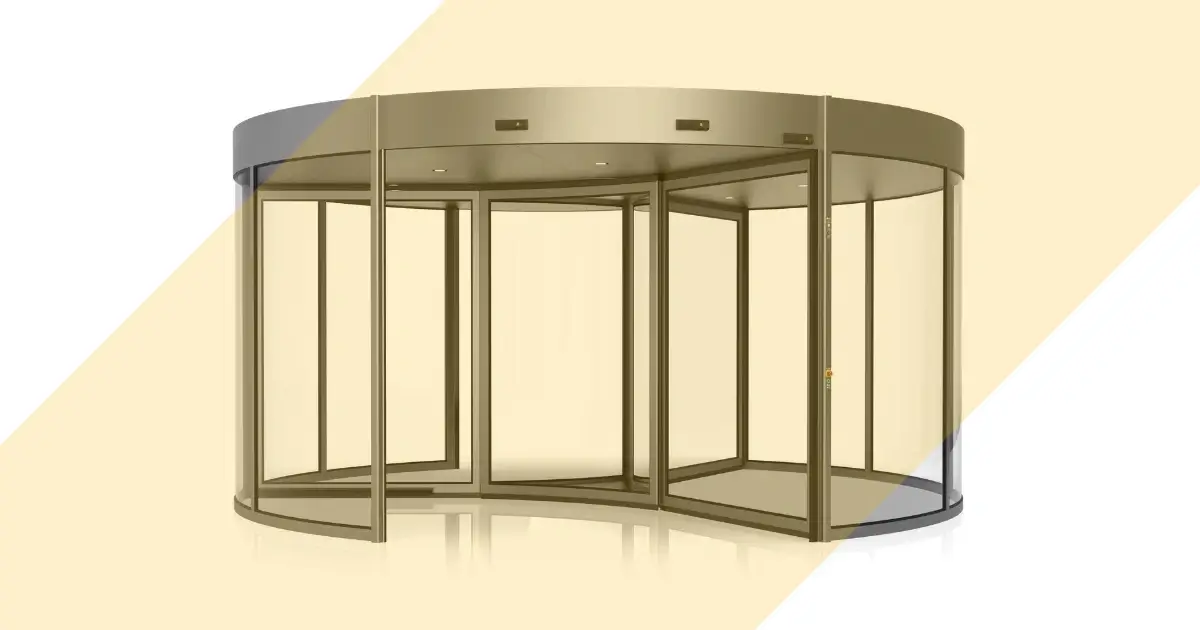
A revolving door is an entrance system with wings that rotate around a central axis within a stationary enclosure. The wings and enclosure form compartments through which people move to enter or leave a building. Rotation can be powered by the user pushing the door or by a motorized mechanism.
Commonly found in hotels, offices and shopping malls, revolving doors combine an architectural entrance feature with a way to limit direct air exchange between indoors and outdoors. Choosing a suitable system requires an understanding of its operation, space requirements and intended users.
How Does a Revolving Door Work?
The operating principle is based on door wings rotating around a central axis. The stationary enclosure and moving wings form the compartments used for passage.
A typical journey involves three stages:
- The user enters a compartment through the entrance opening. With a manual model, the user pushes the wing; with an automatic model, movement follows the selected control arrangement.
- The wings rotate to provide passage. The user walks within the compartment in the direction of movement.
- The user leaves through the opening on the opposite side. The door continues rotating or returns to a waiting position according to its operating mode.
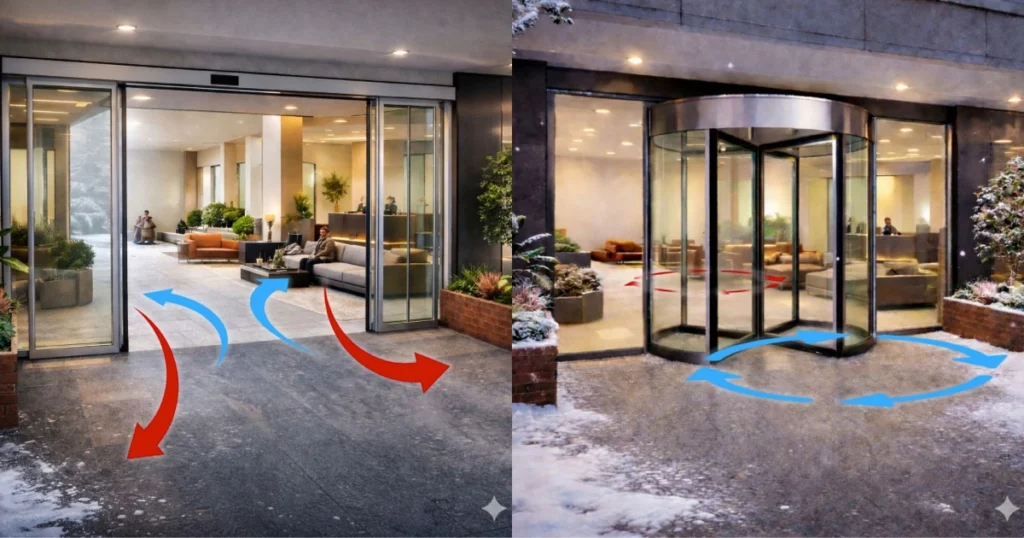
During normal operation, this arrangement limits a continuously open connection between the building interior and exterior. It is not completely airtight: compartment movement, operating clearances and sealing component condition affect air exchange.
What Are the Main Components?
Although designs vary, a revolving door generally includes the following elements:
- Stationary enclosure: Defines the perimeter and the entrance and exit openings.
- Moving wings: Rotate around the central axis to form passage compartments.
- Central support arrangement: Supports the wing connections and rotational movement.
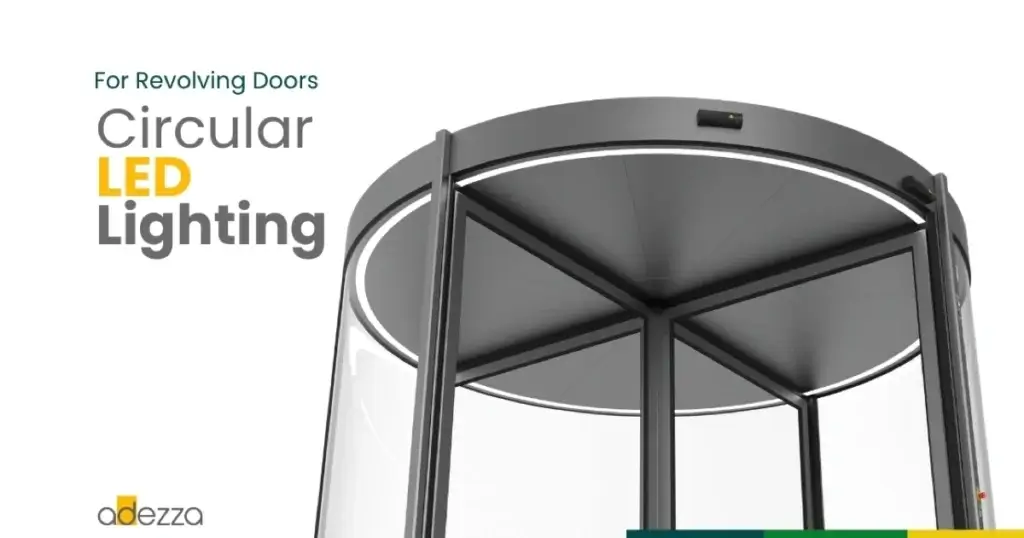
- Overhead structure or canopy: Accommodates or coordinates with the mechanism, lighting and associated equipment, depending on the design.
- Sealing components: Help limit air movement between stationary and moving sections.
- Drive, control and detection equipment: Manage movement and associated protective functions in automatic models.
These components are not identical across every product. Technical drawings and equipment specifications should therefore be reviewed alongside product images.
Manual vs. Automatic Revolving Doors
Manual Revolving Doors
A manual revolving door moves through the force applied by the user. Rotation does not require a motorized drive, although lighting and other auxiliary equipment may still need electricity.
Selection should consider how comfortably users can move the door, the expected pedestrian traffic and maintenance conditions. Manual operation does not mean that maintenance is unnecessary.
Adezza’s manual revolving door options provide a starting point for reviewing this type of entrance.
Automatic Revolving Doors
An automatic revolving door uses a motor and control system to manage wing movement. User detection and operating behavior depend on the selected equipment.
Devices that initiate movement may have different roles from those intended to protect users. Describing a door simply as “sensor-operated” does not explain which functions are provided.
When comparing automatic revolving door systems, review standard and optional equipment together with dimensions and user requirements.
What Do Two-, Three- and Four-Wing Designs Mean?
Wing count is one of the features that determines the internal compartment arrangement. Three- and four-wing doors provide different compartment geometries. Two-wing systems may incorporate different central arrangements or additional passage functions, depending on the model.
For example, Adezza’s ADZ603 Combo two-wing revolving door incorporates an automatic sliding door in its central section. This feature should not be assumed to apply to every two-wing design.
Wing count alone does not establish traffic capacity. Diameter, entrance opening, usable compartment space, operating settings and user behavior should be considered together.
How Is a Revolving Door Different from an Automatic Sliding Door?
A revolving door moves around a central axis. An automatic sliding door moves its panels sideways to create a passage opening.
| Consideration | Revolving door | Automatic sliding door |
|---|---|---|
| Movement | Rotation around a central axis | Panels move sideways |
| Passage arrangement | Users move within compartments | Direct passage when the panels open |
| Space requirement | Circular footprint and approach space | Opening width and space for sliding panels |
| Air exchange | Compartments can limit direct air exchange | Opening size and duration influence air exchange |
| Selection approach | Assess geometry and user needs together | Assess opening, panel arrangement and operating requirements |
Automatic door is a broad term covering motorized doors with different movement types. Automatic revolving doors and automatic sliding doors are two distinct solutions within this group.
The appropriate choice depends on the building’s entrance requirements. Projects comparing alternatives can also review Adezza’s automatic sliding door solutions.
Where Are Revolving Doors Used?
Revolving doors can be considered across several building types:
- Hotels: Guest arrivals, luggage movement and lobby comfort.
- Offices and corporate buildings: Employee and visitor circulation.
- Shopping malls: Entrance planning for changing visitor demand.
- Public and cultural buildings: Entrances serving varied user groups.
- Transport and event venues: Arrangements accounting for peak periods and items carried by users.
- Healthcare buildings: General visitor entrances in suitable projects.
Building type alone is not enough to select a system. Two properties with the same function may have different visitor numbers, operating hours and access requirements.
What Are the Main Benefits?
Helping Control Entrance Air Exchange
Under suitable operating conditions, the compartment arrangement can limit air movement between indoors and outdoors. This may help reduce entrance-related heating and cooling loads.
There is no single energy saving percentage that applies to every building. Climate, the entrance used for comparison and the door system’s own energy consumption should all be considered.
Complementing Architectural Design
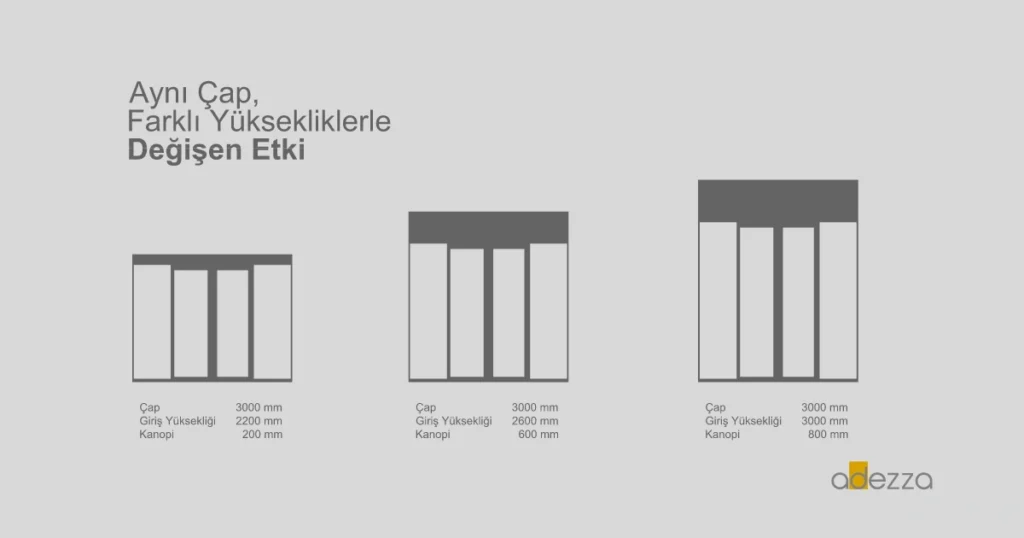
Diameter, height, glazing and finishes influence how the door relates to the facade. Appropriate proportions can help create an entrance that suits the building’s scale and is easy to identify.
Organizing Entry and Exit
Compartments establish a defined movement pattern through the entrance. Adequate space is needed on both sides for this arrangement to work effectively.
Queues at reception desks, ticket checks or security points should not obstruct people leaving the door.
What Roles Do Air Curtains and Aluminum Mats Play?
Additional systems can address different needs within the entrance.
An air curtain uses a directed air stream and may help manage entrance conditions. Compatibility with the door, mounting position and energy consumption should be assessed for the project. It is not a necessary feature for every entrance.
An aluminum entrance mat helps capture dirt and moisture carried on footwear. Its position should be coordinated with finished floor levels and door wing movement.
These systems perform different functions. Their selection should respond to actual entrance requirements rather than being treated as a standard package for every building.
What Should You Consider When Choosing a Revolving Door?
Start with the user profile and pedestrian demand during the busiest periods. Then assess diameter, wing arrangement and clear passage dimensions.
The design process should also establish:
- Requirements for luggage, strollers and other carried items.
- Accessible entrance arrangements and alternative routes.
- Emergency and power failure scenarios.
- The scope of detection and protective equipment.
- Floor, facade and electrical infrastructure details.
- Cleaning, maintenance and service access.
Accessibility and emergency behavior cannot be established simply from the fact that a door is automatic. The selected product and complete entrance arrangement should be checked against the project requirements.
For refurbishment projects, a site survey is particularly useful. Existing floor levels, structural openings and surrounding circulation may influence which options are practical.
Find a Suitable Revolving Door for Your Project
A revolving door brings mechanical operation and architectural design together in a single entrance system. The appropriate model depends on building use, user needs and installation conditions.
Share your entrance dimensions and project requirements with Adezza’s team to discuss manual and automatic options.