Manual vs Automatic Revolving Doors: How to Choose the Right System
Choosing a revolving door for a commercial building involves more than deciding on the appearance of the entrance. The right system should accommodate expected pedestrian traffic, provide a suitable user experience and meet the building’s safety and operational requirements.
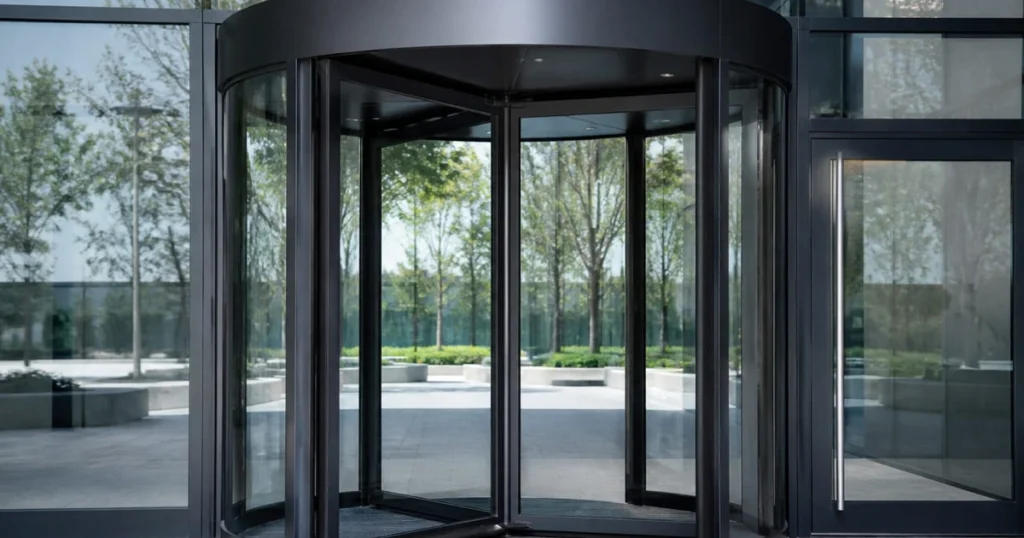
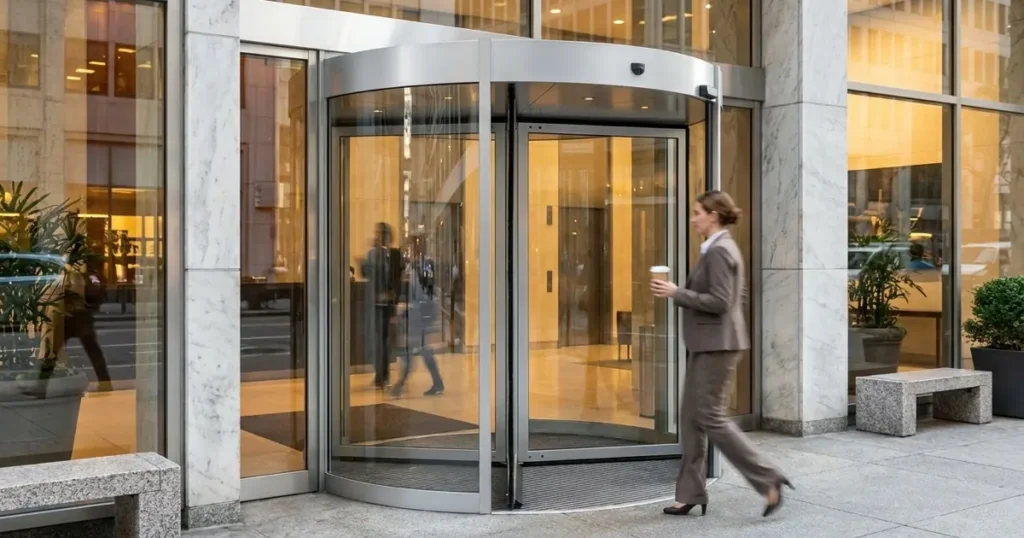
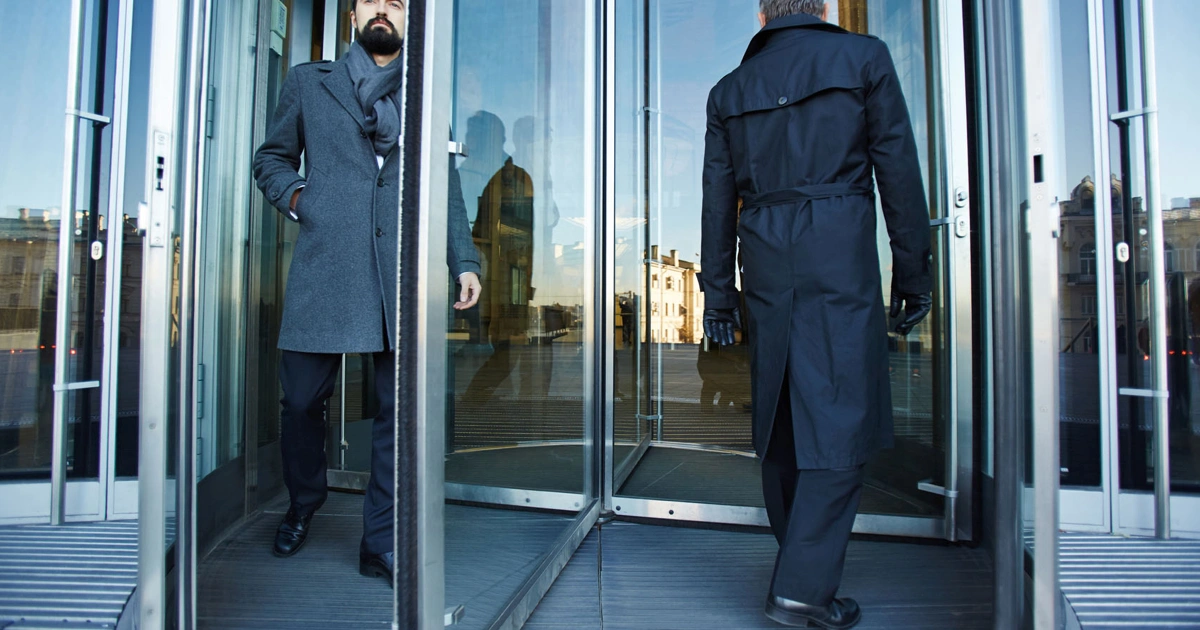
Manual and automatic revolving doors share a similar basic structure. Both use wings that rotate around a central axis within a stationary enclosure, forming compartments through which people enter and leave the building.
The main difference is how the rotation is produced and controlled.
A manual revolving door is operated by the person pushing the door wing. An automatic revolving door uses an electric motor and control system to manage movement.
This distinction affects user effort, movement control, maintenance arrangements and the overall cost of the entrance.
For architects, contractors and building owners, the most suitable solution depends on the building’s actual needs. A manually operated revolving door may work well in a relatively quiet commercial entrance, while an automatic system may be better suited to a hotel or office tower with frequent pedestrian movement.
This guide compares both options and explains how to select a revolving door for different commercial applications.
What Is a Manual Revolving Door?
A manual revolving door is a pedestrian entrance system that rotates when a user applies pushing force to its wings.
The movement takes place around a central axis within a stationary enclosure.
Because the normal rotational movement is not motor-driven, a manual revolving door does not require electrical power for its basic opening mechanism.
However, this does not necessarily make the complete entrance electrically independent. Lighting and other auxiliary equipment may still need an electrical supply.
The main advantage of manual operation is its relatively straightforward movement mechanism.
For certain entrances, this can provide a practical solution without requiring an electric drive and electronic movement controller.
However, the physical effort required to operate the door remains an important consideration.
Door diameter, wing weight, mechanical resistance and user characteristics can all affect the experience.
Adezza’s ADZ103 Manual Revolving Door is designed for applications where user-powered rotation is appropriate.
Its published specifications include different diameter options, laminated glazing, architectural finishes and optional mechanical speed limitation.
What Is an Automatic Revolving Door?
An automatic revolving door uses an electric motor and an electronic control system to manage the rotation of the door wings.
The system can respond to activation equipment and operate according to programmed settings.
Safety devices monitor selected conditions around the moving entrance and provide signals to the controller.
Unlike a manual revolving door, an automatic model does not require users to provide the normal rotational force.
This can be useful where pedestrian traffic is frequent or where building operators need consistent control over movement.
Adezza’s ADZ303 Automatic Revolving Door incorporates motorised operation, an electronic control arrangement and model-specific safety equipment.
Its published specifications identify emergency stop controls and reduced-speed passage buttons at the entrance and exit, together with standard finger protection.
Heel protection, presence detection and light curtain sensors are listed as optional equipment in the published configuration.
Whether any additional protective devices are required must be established for the individual installation.
Manual vs Automatic Revolving Doors: Key Differences
The differences extend beyond the presence of an electric motor.
| Feature | Manual revolving door | Automatic revolving door |
|---|---|---|
| Rotation | Driven by the user | Driven by an electric motor |
| User effort | Requires pushing | No normal pushing force required |
| Operating control | Mechanical movement and available speed-limiting devices | Electronic movement control and safety equipment |
| Electricity | Not required for basic rotation; auxiliary equipment may use power | Required for motor and controller |
| Pedestrian traffic | Can suit appropriate lower-traffic entrances | Can suit frequent or variable pedestrian traffic |
| Maintenance | Primarily mechanical inspections | Mechanical, electrical and control-system inspections |
| Initial cost | Depends on specifications and configuration | Drive and control equipment add to the specification |
| Architectural appearance | Various glazing and finish options | Various glazing and finish options |
These are general differences rather than absolute rankings.
A manual door may be the right choice for one office building but unsuitable for another, even when both have similar entrance dimensions.
The decision should therefore be based on the complete project rather than a single comparison point.
Which Revolving Door Is Better for High Pedestrian Traffic?
Pedestrian volume is one of the most important factors in revolving door selection.
A small commercial building may experience occasional visitor movement throughout the day.
A shopping centre or large office tower, by comparison, can experience concentrated periods of high traffic.
With manual revolving doors, users are responsible for providing the force needed to rotate the wings.
People may push the door at different speeds, and some users may find the movement more demanding than others.
Automatic revolving doors use a controlled motor drive to manage movement according to the configured operating conditions.
This can support a more predictable passage process where pedestrian traffic is frequent.
However, it does not mean that automatic revolving doors have unlimited capacity.
Throughput also depends on diameter, compartment size, wing arrangement, rotation speed and the behaviour of users.
The most suitable system should be selected using expected peak pedestrian demand rather than relying solely on total daily visitor numbers.
For busy commercial entrances, a manufacturer’s passage-capacity information can be particularly useful.
User Comfort: Which Type Is Easier to Use?
Manual and automatic revolving doors provide different experiences for the people passing through them.
With a manual model, the user initiates rotation and continues the movement by pushing.
For many people this may be straightforward, particularly when the door is appropriately sized and its mechanical resistance is suitable.
However, users carrying luggage or other items may find it less convenient.
Automatic revolving doors eliminate the need to push the wings during normal operation.
This can improve convenience in entrances used by diverse groups of visitors.
For example, hotels frequently accommodate guests with luggage, families with children and visitors of different ages.
An automatic revolving door may offer a more comfortable experience in that environment.
Nevertheless, motorised rotation does not automatically establish accessibility for every user.
Wheelchair users, people with reduced mobility and those moving large equipment may require an alternative accessible route or a different entrance arrangement.
Clear passage dimensions and the complete entrance configuration must be reviewed against the project’s requirements.
Where supported, a reduced-speed operating function can provide a more controlled movement option, but it does not replace proper accessibility planning.
Safety Differences Between Manual and Automatic Revolving Doors
Both manual and automatic revolving doors require appropriate safety considerations.
The specific risks depend on the door’s geometry, operating mechanism, movement speed and user population.
Safety in Manual Revolving Doors
Manual revolving doors are moved by users, so the mechanical behaviour of the wings is particularly important.
Uncontrolled acceleration, excessive pushing force or external wind conditions can influence how the door rotates.
Depending on the design, a mechanical speed limiter may be provided to help control excessive rotational speed.
Adezza’s ADZ103 includes an optional mechanical speed-limiting device designed to reduce sudden or uncontrolled movement.
However, a speed limiter does not replace consideration of compartment geometry, trapping points and other relevant safety requirements.
Safety in Automatic Revolving Doors
Automatic revolving doors use motor controls alongside protective devices.
Depending on the product, these may include finger protection, heel sensors, presence sensors, light curtains and emergency stop controls.
Each device serves a different function.
For example, finger protection addresses selected trapping hazards where moving and stationary components approach one another.
Heel protection generally addresses hazards around the lower sections of moving wings.
Presence detection systems may identify people or objects within designated protective areas.
The correct combination depends on the door design and installation-specific risk assessment.
A motorised system should not automatically be described as safer simply because it includes more electronics.
Safety is determined by the complete design, installation, operation and maintenance of the entrance.
Do Manual and Automatic Revolving Doors Have Different Sizes?
Manufacturers may provide different size ranges for manual and automatic product families.
Adezza’s published technical information includes the following examples:
| Adezza model | Operating type | Published nominal diameter range |
|---|---|---|
| ADZ103 | Manual revolving door | Ø1800–3200 mm |
| ADZ303 | Automatic revolving door | Ø1800–4000 mm |
These are published product-family diameter options.
They do not mean that every diameter can be combined with every wing arrangement, height or optional feature.
The final configuration must be confirmed through the relevant technical drawings.
Diameter is also different from clear passage width.
The usable space inside a revolving door depends on the number of wings and the geometry of the compartments.
For example, two doors may have the same nominal diameter but provide different movement experiences because of their wing configurations.
Architects should therefore compare the required clear passage dimensions as well as the external footprint.
For more information, read Revolving Door Dimensions and Height: A Guide to Entrance Sizing.
Are Manual Revolving Doors More Energy-Efficient?
Revolving doors can help limit uncontrolled air exchange between indoor and outdoor environments.
This benefit comes from the moving compartments created by the wings and stationary enclosure.
Both manual and automatic models can provide this type of environmental separation.
A manual revolving door does not consume electricity to drive its normal rotation.
An automatic model requires electrical power for the motor and controller, as well as any associated equipment.
However, motor power alone does not determine the energy efficiency of the complete entrance.
The total result also depends on unwanted air exchange, sealing performance, building climate, wind exposure and pedestrian activity.
An automatic revolving door may provide suitable controlled movement for a busy entrance, while a manual model may be appropriate for a different operating profile.
A reliable energy comparison must consider both the electrical consumption and the heating or cooling loads associated with the entrance.
Neither operating method should be presented as universally more energy-efficient without project-specific information.
Which Revolving Door Requires Less Maintenance?
Manual revolving doors generally have fewer electronic movement-control components than motorised systems.
This can simplify some aspects of maintenance.
However, manual doors still require inspections of mechanical bearings, rotation mechanisms, glazing, seals and other relevant components.
Where mechanical speed-limiting equipment is installed, it must also be checked according to the manufacturer’s instructions.
Automatic revolving doors require mechanical maintenance together with inspection of their electric drive, control system and protective equipment.
Sensors need to be appropriately positioned and their safety functions tested.
The required frequency depends on the product, level of use and environmental conditions.
For example, a heavily used manual revolving door may experience greater mechanical wear than a lightly used automatic system.
Consequently, it would be misleading to assume that every manual door costs less to maintain.
Maintenance should be evaluated using the actual operating conditions and the manufacturer’s requirements.
Manual vs Automatic Revolving Door Cost
The price difference between manual and automatic revolving doors depends on the complete technical specification.
Removing the motor and electronic control components can reduce the scope of a manual configuration.
However, the overall door dimensions, glazing, architectural finishes and optional features may account for a substantial part of the cost.
For example, a large custom manual revolving door with specialised stainless steel cladding may not necessarily cost less than a smaller automatic model with standard finishes.
A meaningful comparison should use equivalent dimensions, glazing specifications and installation requirements.
Long-term operating costs should also be considered.
These may include electrical consumption, scheduled maintenance, replacement components and service requirements.
The right choice is not always the system with the lowest initial quotation.
It is the configuration that meets the required user, safety and operational needs at an appropriate total cost.
Which Revolving Door Is Suitable for Different Building Types?
Office Buildings
A manual revolving door may be appropriate for an office entrance with relatively modest pedestrian demand.
In large office towers, concentrated traffic during arrival and departure periods may favour automatic movement.
The decision should reflect peak pedestrian demand and the available entrance space.
Hotels and Hospitality Properties
Hotels regularly accommodate guests with luggage, groups and visitors of different ages.
Automatic revolving doors can be attractive because users do not need to provide rotational force.
However, a manual model may still be suitable for a quieter hotel entrance where the usage conditions support it.
Accessible entrance arrangements must be considered in either case.
Shopping Centres
Shopping centres frequently experience changing levels of pedestrian traffic.
Automatic revolving doors may help provide controlled movement in these environments.
The selected model must nevertheless have an appropriate diameter, wing arrangement and passage capacity.
Larger or more specialised systems may be considered where standard models cannot meet the entrance requirements.
Healthcare and Public Buildings
Healthcare and public buildings serve people with a wide range of mobility needs.
An automatic revolving door can reduce the effort required for normal operation.
However, both manual and automatic designs must be assessed for suitable access, clear passage dimensions and emergency requirements.
Where necessary, separate accessible routes and appropriate alternative entrances must form part of the design.
What Happens During a Power Failure?
Power failure behaviour is an important consideration, particularly in commercial buildings.
A manual revolving door does not require a motor to produce normal rotation.
However, lighting, electronic locking arrangements or other auxiliary devices may still be affected by loss of electrical supply.
An automatic revolving door relies on electric components for its motorised operation.
Its response during a power failure depends on the controller, locking arrangement and any backup power system.
Not every automatic revolving door automatically converts to manual operation when power is lost.
The required behaviour must be confirmed for the selected model and the building’s emergency strategy.
A suitable entrance should be evaluated as part of the building’s complete accessibility and evacuation arrangements.
Common Mistakes When Choosing a Revolving Door
One common mistake is choosing between manual and automatic models based on initial price alone.
A lower-cost manual configuration may not suit an entrance where visitors require frequent, convenient passage without pushing.
Conversely, an elaborate automatic system may introduce unnecessary equipment where the expected traffic and user needs do not justify it.
Another mistake is assuming that automation automatically meets all accessibility and safety requirements.
Diameter, compartment geometry, the need for alternative routes and the complete safety design remain important.
Maintenance and long-term operating conditions should also be considered before finalising a specification.
The best approach is to evaluate both door types against the same project requirements.
Choosing Between Adezza ADZ103 and ADZ303
Adezza offers manual and automatic revolving door solutions for commercial entrance projects.
The ADZ103 Manual Revolving Door provides user-powered rotation, different architectural finish options and model-specific mechanical features.
The ADZ303 Automatic Revolving Door offers motorised operation, electronic controls and a range of activation and protective equipment options.
Neither model should be selected solely because it is manual or automatic.
The correct specification depends on the entrance dimensions, pedestrian traffic, user characteristics and the operational requirements of the building.
Explore Adezza’s revolving door product range and compare the published technical drawings for both models.
For a project-specific recommendation, share your entrance measurements, expected peak traffic and design requirements with Adezza and request a quotation.