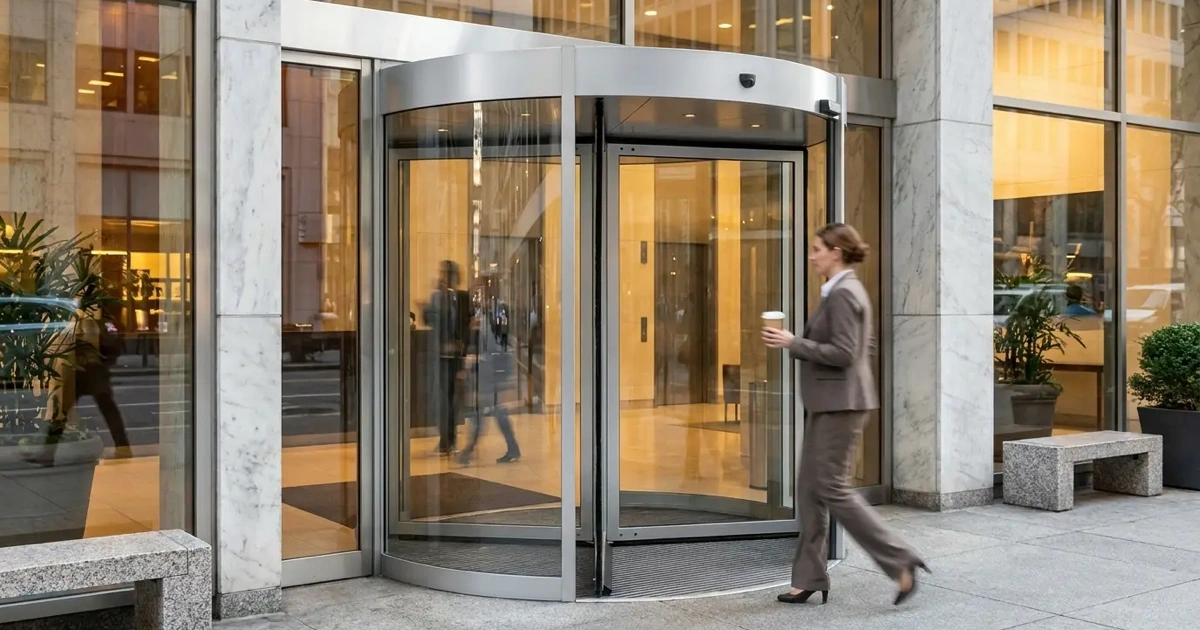
What Are Access-Controlled Revolving Doors? How Card-Based and Secure Entry Works
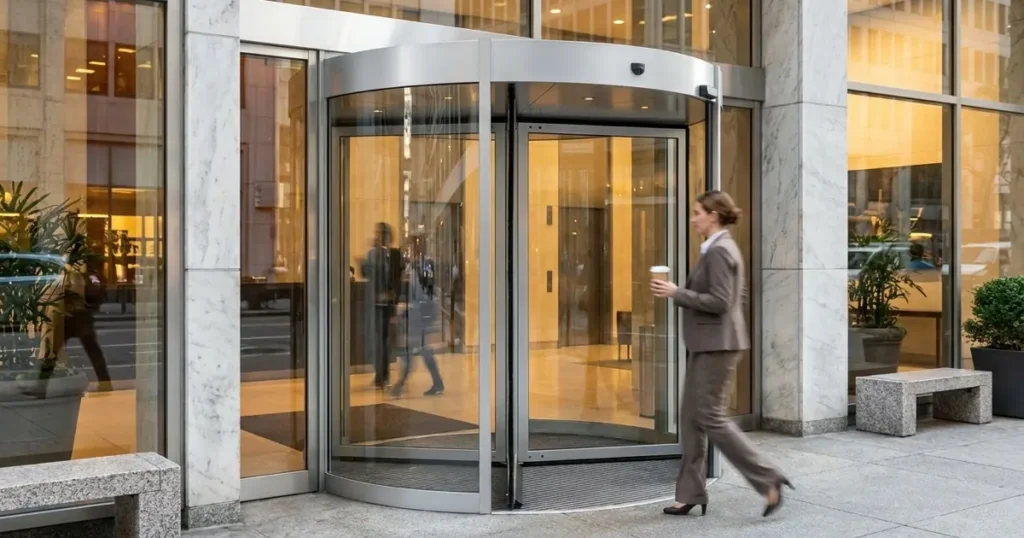
Access-controlled revolving doors combine a motorised pedestrian entrance with an authorisation system designed to manage who may enter or leave a building. When compatible access control equipment is integrated with the door controller, users can be granted passage through card readers, RFID credentials or other approved identification methods.
These systems can be relevant to corporate offices, administrative buildings, commercial developments and facilities where pedestrian access needs to be managed.
However, adding a card reader to an automatic revolving door does not automatically create a high-security entrance. Authorising a credential, detecting an individual passage and preventing unauthorised tailgating are different functions.
A suitable design must consider the door mechanism, access control technology, safety equipment, pedestrian traffic and emergency operation together.
This guide explains how access-controlled revolving doors work, the differences between card-based entry and high-security passage control, and the requirements that should be evaluated before selecting a system.
What Are Access-Controlled Revolving Doors?
Access-controlled revolving doors are entrance systems in which permission to operate the door can be linked to an external or integrated authorisation process.
A conventional automatic revolving door may respond to activation sensors according to its operating mode. An access-controlled configuration can instead require a successful authorisation signal before permitting a particular entrance movement.
For example, a corporate building may want employees to use access cards when entering a restricted area.
A compatible access control system can verify the employee’s permission and send a passage request to the revolving door controller.
The door then responds according to its operating logic and safety conditions.
The level of control depends on the equipment installed. A general-purpose revolving door with an access reader is not necessarily equivalent to a dedicated security revolving door engineered for individual passage verification.
This distinction should be established early in a project.
How Does Card Access Work on Revolving Doors?
Card-based access involves several systems working together: the credential, reader, access controller and the revolving door’s control equipment.
1. The User Presents a Credential
The user presents an authorised access card to a compatible reader.
In an RFID-based arrangement, the reader communicates with the credential without direct physical contact.
The identification information is then processed according to the access control system’s configuration.
Reading a card is not the same as granting access. The user’s permissions must first be evaluated.
2. The Access Controller Checks Permission
The access controller determines whether the credential is permitted to request passage.
Depending on the installed platform, permissions may be based on the user, door location, direction of travel and permitted time schedule.
For example, an office employee may be authorised to enter a building during specified working hours, while a visitor may receive access for a limited period.
If the required conditions are not met, the system can deny the access request.
3. The Door Controller Receives a Passage Request
When access is granted, the access control equipment can send a compatible signal to the revolving door controller.
The door controller evaluates that request alongside its operating state and protective functions.
If the relevant conditions are satisfied, the system may begin rotation or enter a designated passage mode.
The reader itself does not normally replace the motor control and safety logic. It forms part of the authorisation process.
4. The Passage Is Completed
The authorised user moves through the revolving door compartment.
Depending on the system’s sensors and monitoring capabilities, the controller may identify particular movement or passage events.
After the operating sequence is completed, the door may return to a waiting or another predefined operating state.
It is important to distinguish a successful card authorisation from confirmation that one person has passed.
If accurate passage verification is required, additional detection or monitoring functions may be necessary.
Which Access Control Methods Can Be Used?
Access-controlled revolving doors may be designed around different authorisation technologies.
The appropriate method depends on the building’s security policy, credential management requirements and compatibility with the selected entrance equipment.
RFID Card Readers
RFID access systems allow users to present a contactless credential to a reader.
They can be practical for office buildings and staff entrances where individual permissions need to be managed centrally.
Depending on the access control software, permissions can be assigned to different user groups, updated or revoked.
The security of the complete arrangement depends on the credential technology and how authentication is implemented.
PIN and Keypad Entry
Keypads allow users to request access through an assigned code.
This approach may be considered for particular locations, but shared codes can introduce security and accountability limitations.
For environments requiring individual user identification, a shared PIN alone may not provide the desired level of control.
Mobile Credentials and QR Codes
Compatible access control platforms may support mobile credentials or temporary QR codes.
These can be useful for visitor management, particularly where access permission is issued before arrival.
However, integration depends on the reader, access controller and revolving door’s available interfaces.
Biometric Access Control
Some specialised security entrance systems can be used with biometric verification technologies.
Biometric authentication introduces additional considerations involving personal data protection, consent or other applicable lawful processing conditions, security and credential management.
Compatibility must be assessed for the complete solution. Biometric support should not be assumed to be standard on every automatic revolving door.
Access-Controlled Revolving Doors vs Turnstiles
Revolving doors and turnstiles can both be used in controlled pedestrian environments, but they are different types of entrance systems.
A revolving door has rotating wings within an enclosure. It may form part of a building’s external façade and can help limit direct air exchange between indoor and outdoor areas.
A turnstile typically regulates passage through arms, barriers or other controlled moving elements.
| Feature | Access-Controlled Revolving Door | Turnstile |
|---|---|---|
| Mechanical design | Rotating door wings and enclosure | Arms or moving passage barriers |
| Typical placement | Building entrance or façade | Dedicated access control point |
| Credential systems | Requires compatible access control integration | Requires compatible access control integration |
| Environmental separation | Revolving door construction may limit direct air exchange | Does not generally provide the same enclosed entrance arrangement |
| Individual passage verification | Requires purpose-designed monitoring where needed | Depends on the turnstile model and sensing equipment |
| Design priority | Architectural entrance and secure access requirements | Managed pedestrian passage |
The correct solution depends on the required security level, available space and user experience.
A building that needs only employee credential checks may have different requirements from a facility that must positively verify each individual entering a protected zone.
Can One Access Card Prevent Multiple People from Entering?
One of the most important limitations of basic card access is that authorisation does not necessarily prove that only one person entered.
An unauthorised person may attempt to follow an authorised user through the same entrance sequence.
This is commonly described as tailgating or piggybacking.
A standard card reader primarily checks whether the presented credential has permission.
It does not necessarily count the number of people entering a revolving compartment.
High-security revolving door systems may incorporate dedicated passage monitoring equipment to detect multiple occupants or other unauthorised movement conditions.
Depending on the approved design, monitoring technologies may include optical detection, compartment occupancy sensing or other specialised arrangements.
These features should not be confused with standard door safety sensors.
Heel protection, finger protection and presence sensors are generally used to manage hazards associated with moving door components. Their presence does not establish that the door is capable of reliable anti-tailgating detection.
If individual passage verification is required, the project specification must identify that requirement explicitly.
Can Entry and Exit Be Controlled Separately?
Access control systems can support different authorisation rules for entry and exit when the door mechanism and controller are designed to accommodate them.
For example, a corporate entrance may require credential verification for entry while allowing exit through a separate, approved control arrangement.
Other installations may need authorisation in both directions.
Directional access control must be evaluated as part of the complete entrance design, not simply configured in software without considering the mechanics.
Emergency egress requirements are particularly important.
A controlled entrance must not create an unsafe situation during evacuation or other emergency conditions. Any locking, release or emergency operation arrangement must meet the applicable requirements for the building and the approved door system.
What Safety Features Are Needed?
Access authorisation and operational safety are separate functions.
Card readers identify whether a user is permitted to request passage. Safety systems address the hazards associated with the moving revolving door.
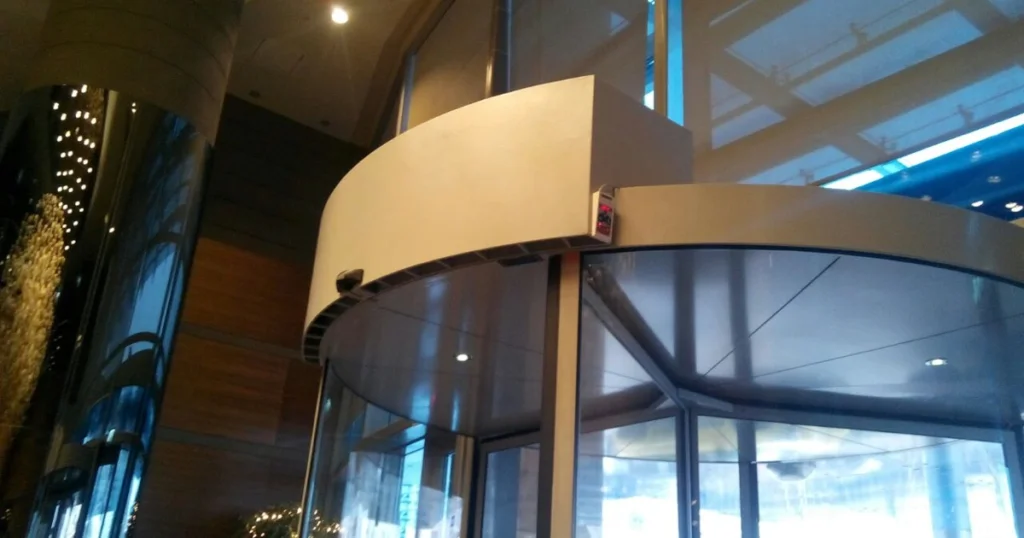
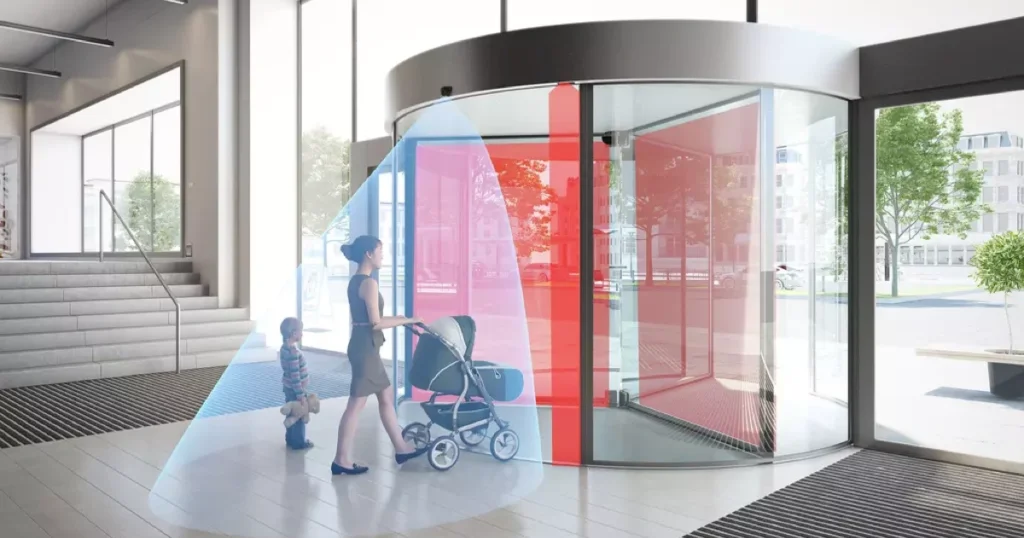
Depending on the product and configuration, automatic revolving doors may use activation radar, finger protection devices, heel sensors, presence sensors, light curtains and emergency stop controls.
These components monitor different areas and provide different protective responses.
A valid credential must not override the protective conditions required for safe door movement.
Similarly, an access restriction must not compromise the emergency operating behaviour established for the entrance.
Applicable standards for power-operated pedestrian doors, including EN 16005 and its relevant amendments where applicable, should be considered alongside local building and fire safety requirements.
The correct assessment concerns the complete installed system rather than individual components considered in isolation.
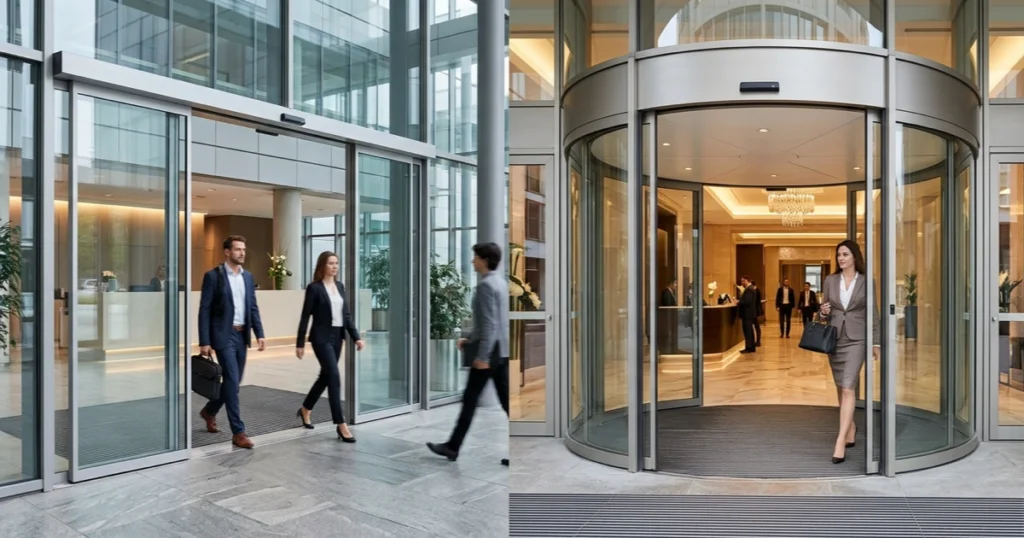
Where Are Access-Controlled Revolving Doors Used?
Corporate Offices
Office buildings may use individual credentials to separate employee access from visitor movement.
Access permissions can be organised around departments, operating hours or designated building areas, depending on the installed access control platform.
The entrance must also accommodate concentrated pedestrian traffic during peak arrival and departure periods.
Administrative Buildings
Administrative facilities may include public reception areas and restricted internal zones.
In some cases, a revolving door can form part of the public entrance while access control is implemented at a separate point within the building.
Where a controlled revolving door is appropriate, the required security functions should be defined during the design phase.
Industrial Facilities
Factories and industrial sites often need to distinguish between staff, visitors, contractors and delivery operations.
Shift changes, personal protective equipment and the movement of people carrying materials can affect the entrance specification.
A revolving door should be selected only after these requirements and the site’s security arrangements have been evaluated.
Hotels and Mixed-Use Developments
Hotels and mixed-use buildings may require different access permissions for public lobbies, residential areas and restricted facilities.
The appropriate solution might involve an access-controlled revolving entrance or a separate controlled doorway.
Guest convenience, accessible routes and expected pedestrian traffic should remain part of the decision.
What Should Be Checked Before Specifying an Access-Controlled Revolving Door?
The first step is to define what the access control arrangement must achieve.
Is the objective to allow credential-based entry, restrict entry at particular times or verify one individual per authorisation?
These are different requirements and may need substantially different equipment.
The project team should also evaluate door diameter, wing arrangement, pedestrian throughput, available installation space and the expected user population.
The integration process needs a clear description of the access controller’s interface, the signals exchanged with the door controller and the required response to faults.
Locking functions, emergency operation, power failure behaviour and maintenance access must also be reviewed.
If passage events are recorded, the associated personal data and system security requirements should be addressed appropriately.
For more information about sizing, see Revolving Door Dimensions and Height: A Selection Guide.
Evaluating Access Control with Adezza Revolving Door Systems
Adezza offers automatic revolving door products for different building entrance arrangements.
The ADZ303 Automatic Revolving Door includes a standard control panel and model-specific safety equipment options. An electromechanical motor lock is also listed as an optional component.
The ADZ603 Combo 2-Leaf Revolving Door combines revolving door operation with an integrated automatic sliding door arrangement, providing a different configuration for entrance design.
These product features should not be interpreted as confirmation that all card reader systems or high-security individual passage functions are supported as standard.
For a project requiring RFID card access, directional authorisation or detailed passage monitoring, compatibility must be established for the specific door model and proposed control equipment.
A successful access-controlled entrance is the result of coordinated mechanical design, authorisation technology, movement safety and operational planning.
Explore Adezza’s revolving door products and request a project quotation with details of your existing access control system, entrance dimensions and security requirements.