Types of Revolving Doors: Which Model Is Right for Your Building?
Types of revolving doors vary considerably in their operating mechanisms, architectural design and suitability for different commercial entrances. From manually operated models to large automatic revolving doors with integrated sliding functions, each configuration addresses a different combination of building requirements.
For architects, contractors and building owners, choosing the right revolving door involves more than selecting a design that complements the façade. The entrance must also accommodate expected pedestrian traffic, suitable passage dimensions, safety requirements and the needs of people using the building.
A hotel welcoming guests with luggage may need a different entrance arrangement from a corporate office with concentrated morning traffic. A shopping centre may require larger passage compartments, while a glass-fronted office building may place greater emphasis on architectural transparency.
This guide compares the main types of revolving doors, explains the differences between six Adezza models and explores which configurations may suit hotels, shopping centres, healthcare facilities and other commercial buildings.
What Are the Main Types of Revolving Doors?
Revolving doors can be classified according to their operating mechanism, wing configuration and architectural construction.
The most fundamental distinction is between manual and automatic revolving doors.
Manual systems rely on users to initiate and maintain rotation, while automatic revolving doors use a motor and electronic controls.
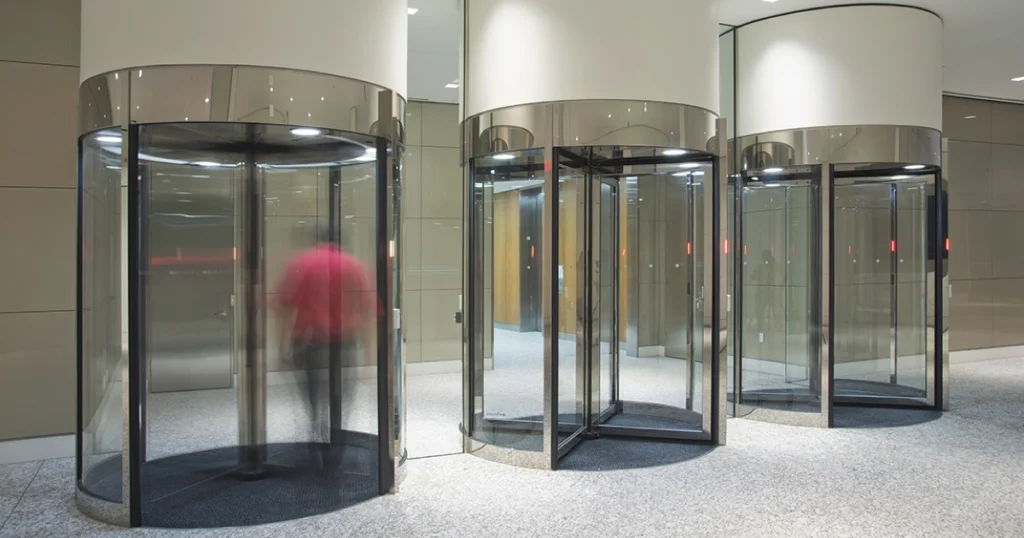
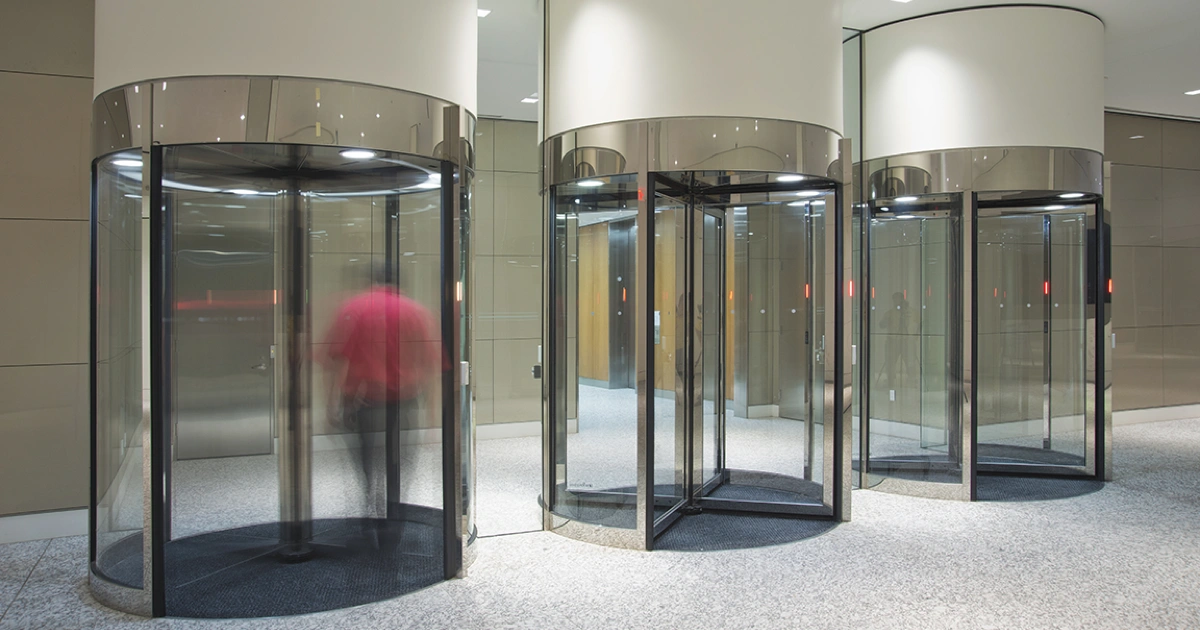
Other model categories describe architectural or functional features. Glass-centred, glass-roof and showcase revolving doors have distinctive structural arrangements, while combined systems integrate additional movement functions.
This means the categories are not always mutually exclusive. A glass-focused revolving door design may also have an automatic operating configuration.
Adezza’s revolving door range includes six principal model families:
| Model | Revolving door type | Main consideration |
|---|---|---|
| ADZ103 | Manual revolving door | User-powered passage |
| ADZ303 | Automatic revolving door | Motorised pedestrian entrance |
| ADZ203 | Glass-centred revolving door | Architectural transparency |
| ADZ403 | Glass-roof revolving door | Transparent canopy and daylight |
| ADZ503 Vista | Showcase revolving door | Large entrance and display areas |
| ADZ603 Combo | Two-leaf hybrid revolving door | Revolving and sliding passage functions |
The right choice depends on the building’s actual requirements rather than the category name alone.
Manual Revolving Doors: ADZ103
Manual revolving doors operate through the force applied by users to the rotating wings.
Unlike automatic models, the normal rotation does not depend on an electrically powered drive mechanism.
This can make manual systems worth considering for entrances where pedestrian numbers and user characteristics are suitable for a manually operated door.
However, manual operation is not necessarily the simplest choice for every building.
The effort required to rotate the wings, the available compartment space and the characteristics of the people using the entrance must be assessed.
For example, a low-traffic office entrance may present a different set of requirements from a busy hotel where guests frequently carry luggage.
Adezza’s ADZ103 Manual Revolving Door has published nominal diameter options from Ø1800 mm to Ø3200 mm.
Manual revolving doors can be appropriate for certain commercial and institutional entrances, provided the complete installation meets the project’s functional, safety and accessibility needs.
Automatic Revolving Doors: ADZ303
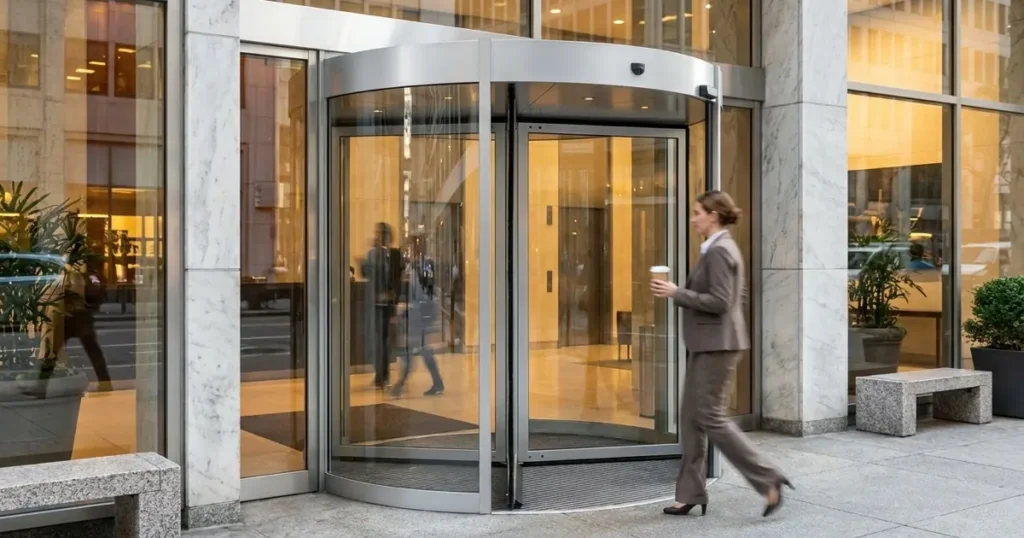
Automatic revolving doors use a motor-driven mechanism to rotate the wings within a stationary enclosure.
Electronic controls manage the operating sequence, while activation and safety equipment respond to selected conditions around the entrance.
This operating method can be useful in commercial buildings with variable pedestrian demand.
For example, an office tower may experience high arrival traffic during the morning and concentrated departure traffic later in the day.
The entrance design should account for these peaks alongside the door’s rotation speed, compartment configuration and usable passage dimensions.
Adezza’s ADZ303 Automatic Revolving Door offers published diameter options from Ø1800 mm to Ø4000 mm, subject to the approved configurations.
Available features include a standard control panel and model-specific activation and safety equipment.
Automatic operation can help create a controlled movement pattern, but it does not automatically make the entrance suitable for every mobility or emergency egress requirement.
These matters must be evaluated as part of the complete building design.
Glass-Centred Revolving Doors: ADZ203
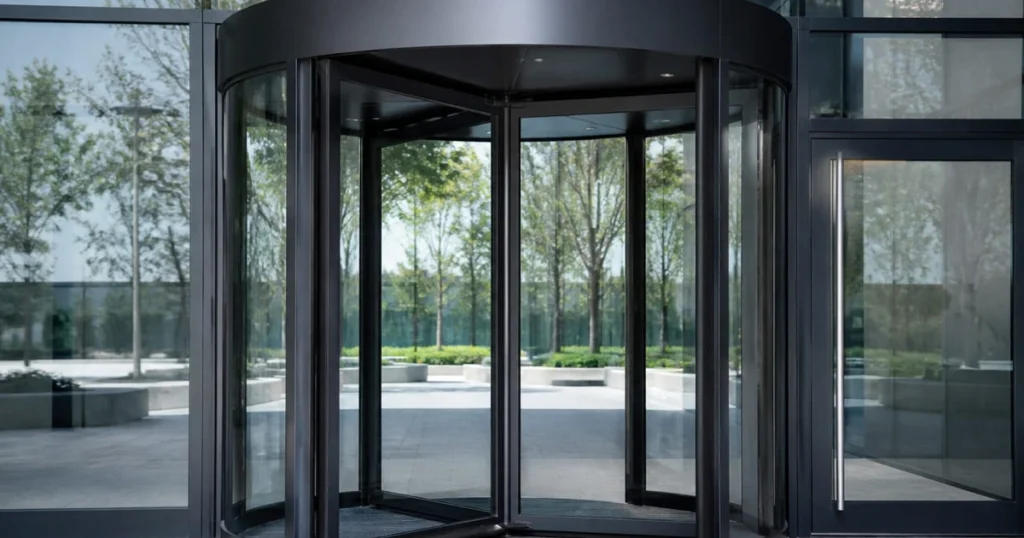
Glass-centred revolving doors are designed to provide a visually lighter entrance arrangement.
Their architectural appeal comes from the emphasis on transparency and reduced visual interruption between indoor and outdoor spaces.
This can be particularly valuable in buildings where glazing plays a major role in the façade design.
Consider a modern corporate headquarters with a largely transparent lobby. A revolving door with a visually dominant central structure may interrupt the intended architectural appearance.
A glass-centred design can provide a more integrated solution.
Adezza’s ADZ203 Glass Centered Revolving Door is presented for architectural applications with diameters up to approximately 3 metres.
The model family is positioned around transparency, minimalist detailing and visual continuity.
Such systems may be considered for office towers, hotels, institutional buildings and commercial projects where the design of the entrance is particularly important.
Operating configuration, glazing details and installation suitability must still be verified against the selected product specification.
Glass-Roof Revolving Doors: ADZ403
Glass-roof revolving doors extend the use of transparent materials into the overhead structure.
Their distinctive feature is the glass canopy, which can allow natural daylight to enter the surrounding space and create a lighter architectural appearance.
These systems can be useful in large glazed façades, hotel entrances and commercial buildings where the entrance forms part of a transparent architectural composition.
The difference between a glass-centred and glass-roof revolving door is important.
A glass-centred design emphasises the appearance of the central structure, while a glass-roof model focuses on the transparency of the overhead construction.
Adezza’s ADZ403 Glass Roof Revolving Door uses laminated safety glass and supporting aluminum components in its transparent canopy arrangement.
The product design also places relevant drive and control components away from the transparent upper section to maintain the visual character of the glass roof.
When specifying this type of revolving door, the design team should evaluate structural support, glazing safety, water management and maintenance access as well as architectural appearance.
Vista Showcase Revolving Doors: ADZ503
Showcase revolving doors are large entrance systems that combine pedestrian passage with designated display areas.
They are particularly relevant where the building requires a substantial revolving-door footprint and the entrance has an important architectural or commercial presentation role.
Adezza’s ADZ503 Vista Showcase Revolving Door has published diameter options of Ø4200, Ø4500, Ø5000 and Ø6000 mm.
These sizes make the product family suitable for consideration in spacious entrance areas.
The showcase compartments can also be used for appropriate display or promotional arrangements, subject to the design and operational requirements.
Potential applications include shopping centres, major commercial buildings, hotels and large public-facing developments.
However, larger diameter does not automatically guarantee a particular pedestrian capacity.
Throughput depends on compartment geometry, rotation speed, user behaviour and the surrounding circulation layout.
The decision to use a Vista model should therefore be based on both its architectural value and its practical entrance performance.
Combo Two-Leaf Revolving Doors: ADZ603
Combined revolving door systems offer more than one passage function within a single entrance arrangement.
Adezza’s ADZ603 Combo 2-Leaf Revolving Door combines a two-leaf revolving structure with an automatic sliding door in the central section.
This allows different entrance operating scenarios to be considered within the same product family.
For example, a large commercial entrance may need conventional revolving-door passage during normal periods while also requiring a more direct opening for certain activities.
In healthcare environments, the movement of stretchers and wheeled equipment may create additional entrance requirements.
The ADZ603 has published diameter configurations of Ø3600, Ø4200, Ø4800 and Ø5400 mm.
The integrated sliding function makes it particularly relevant to projects seeking flexibility between revolving and direct passage.
However, the existence of a central sliding door does not automatically establish compliance with accessibility or emergency egress requirements.
Clear opening dimensions, operating modes, backup power arrangements and the complete safety design must be verified for the specific installation.
Three-Wing vs Four-Wing Revolving Doors
Wing configuration influences the geometry of the compartments formed inside a revolving door.
A three-wing system creates three rotating compartments, while a four-wing arrangement creates four.
This affects how space is distributed and how users move through the entrance.
However, it is not appropriate to assume that a particular wing count is universally more comfortable or offers greater pedestrian capacity.
A door’s usable space also depends on its diameter and internal design.
For entrances accommodating people with luggage, compartment dimensions deserve particular attention.
The final choice should be supported by model-specific technical drawings and capacity information.
For a more detailed explanation, see Revolving Door Dimensions and Height: A Guide to Diameter and Clear Passage Width.
Which Revolving Door Is Best for Different Buildings?
Different building types have distinct operating conditions. The following examples provide a starting point for selecting suitable revolving door models.
Hotels and Hospitality Buildings
Hotels need entrances that combine appearance, comfort and practical passage for guests carrying luggage.
An ADZ303 automatic revolving door may suit a hotel with regular pedestrian activity.
For a premium architectural entrance, ADZ203 glass-centred and ADZ403 glass-roof models may also be worth considering.
Where a larger opening and multiple passage scenarios are required, the ADZ603 Combo can provide another option.
The entrance should always be evaluated for luggage movement, accessible routes and the actual arrival patterns of guests.
Shopping Centres and Retail Developments
Shopping centres can experience substantial variations in pedestrian traffic throughout the day.
Large entrance systems such as the ADZ503 Vista and ADZ603 Combo may be appropriate where the available space and traffic requirements support them.
The ADZ303 may also suit entrances with different dimensions or operational requirements.
The design should account for the approach area, congestion during peak periods, safety sensors and alternative passage routes.
Offices and Corporate Headquarters
Office buildings often need an entrance that supports regular pedestrian movement while complementing the corporate architecture.
The ADZ303 provides a motorised solution for commercial entrances.
Where architectural transparency is a central design priority, ADZ203 and ADZ403 models may be considered.
For lower-traffic entrances where manual operation is appropriate, ADZ103 provides another alternative.
If credential-based entry is required, the access control arrangement and its compatibility with the selected revolving door must be assessed separately.
Hospitals and Healthcare Facilities
Healthcare entrances require particular attention to accessibility, patient movement and the passage of wheeled equipment.
A combined system such as the ADZ603 may be considered where direct passage functionality is required alongside revolving operation.
However, the suitability of any model depends on the clear opening, safety arrangement and complete entrance configuration.
Accessible alternative routes, stretcher access and emergency egress must be addressed as part of the building design.
Public and Institutional Buildings
Public buildings serve users with different mobility characteristics and movement patterns.
The entrance may also experience significant variations in traffic during the day.
Automatic revolving doors can be evaluated where their capacity and operating characteristics suit the building.
For projects with additional security requirements, access authorisation must be distinguished from movement safety.
A standard revolving door with safety sensors should not automatically be regarded as a high-security, one-person-per-authorisation entrance.
What Should You Consider When Choosing a Revolving Door Model?
The first step is to understand how people will use the entrance.
Expected pedestrian volume, peak traffic periods, luggage movement and accessibility requirements influence the type of door that may be suitable.
The next step is to assess the available physical space.
Door diameter, clear passage width, overall height and canopy dimensions must be compatible with the building.
Safety equipment is equally important. Finger protection devices, heel sensors, presence sensors and light curtains have different functions and may be standard or optional depending on the product.
The building’s environmental conditions should also be considered.
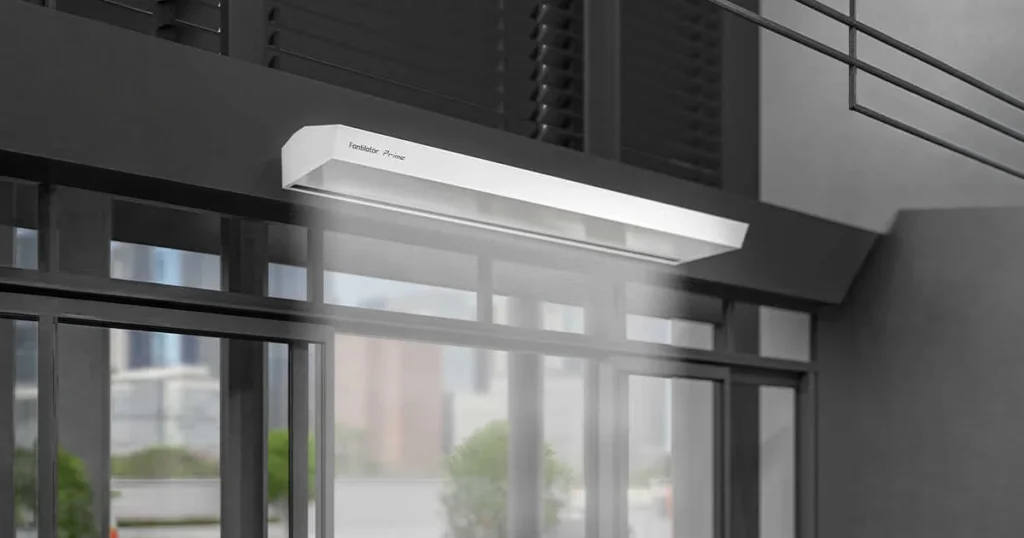
Wind exposure, temperature differences and entrance operation can affect comfort and energy performance. Where justified, additional equipment such as an air curtain may be evaluated.
Finally, maintenance requirements, operating costs and long-term service arrangements should form part of the selection process.
The correct revolving door is not necessarily the largest or most elaborate model. It is the configuration that satisfies the project’s technical and architectural needs.
Explore Revolving Door Models from Adezza
Adezza offers manual, automatic, glass-centred, glass-roof, showcase and combined revolving door systems.
Each model family provides a different approach to commercial entrance design.
An office building, hotel, shopping centre or healthcare facility may require a different combination of passage capacity, transparency, automation and operational flexibility.
Selecting a suitable revolving door begins with comparing the available models against the building’s actual requirements.
Explore Adezza’s revolving door product range to review technical specifications and drawings.
For a project-specific recommendation, share your entrance dimensions, architectural drawings and expected pedestrian traffic with Adezza and request a quotation.