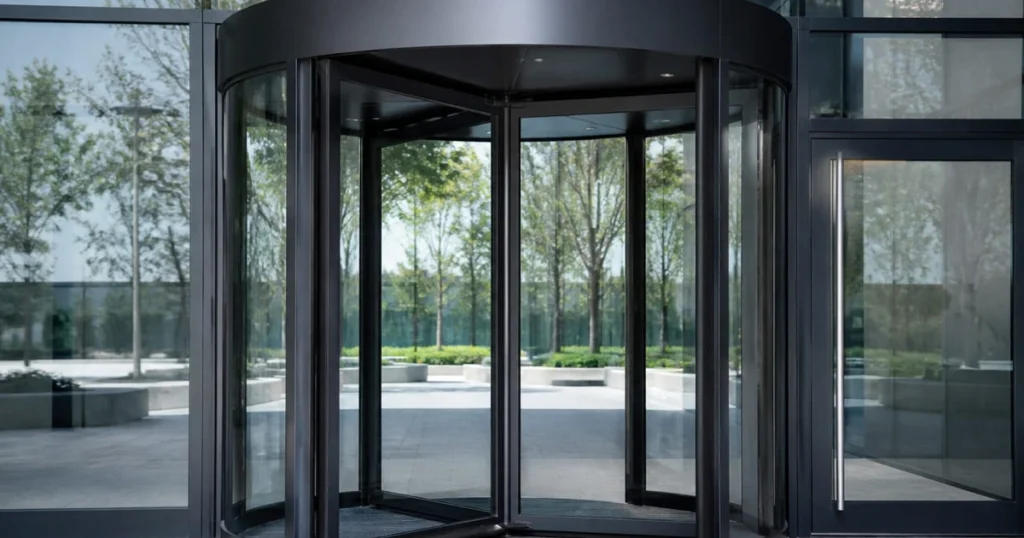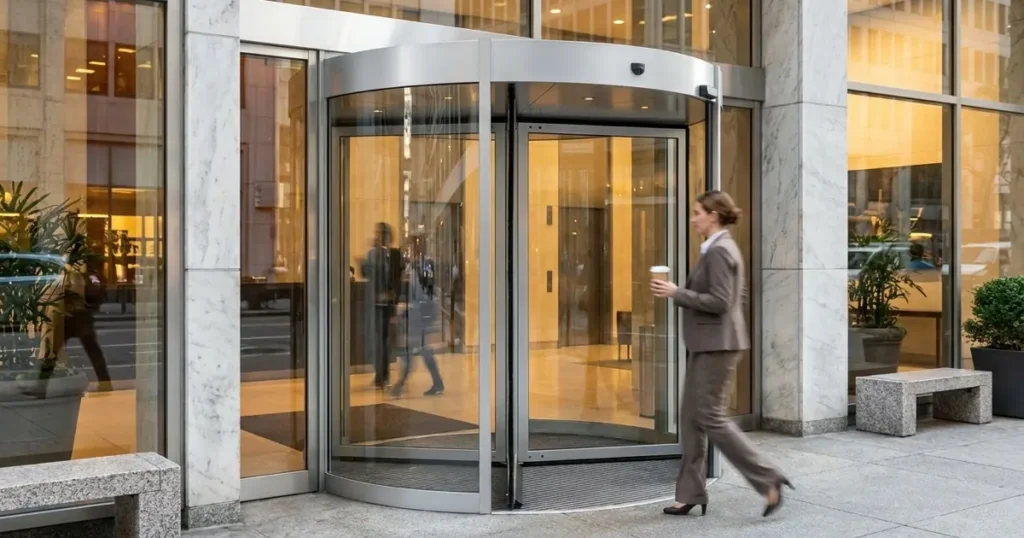
Automatic revolving door cost is an important consideration for architects, contractors and building owners planning a commercial entrance. However, revolving door prices are rarely determined by a single standard specification. Diameter, height, wing configuration, glazing, automation equipment and installation requirements can all influence the final quotation.
Consider two automatic revolving doors with the same nominal diameter. One may feature a standard aluminum finish and conventional control panel, while the other incorporates custom stainless steel cladding, additional safety devices and specialised entrance equipment. Although their dimensions appear similar, the manufacturing and installation requirements can be substantially different.
For this reason, comparing automatic revolving door prices requires more than reviewing the total amount shown on a quotation. Buyers should understand which components are standard, which are optional and which installation services are included.
The following seven factors explain what typically influences revolving door pricing and how to evaluate quotations for commercial projects.
1. Revolving Door Diameter and Height
The physical dimensions of an automatic revolving door are among the primary factors affecting its cost.
Door diameter influences the overall footprint, curved enclosure, glazing dimensions and supporting structure. Height introduces additional considerations involving wing construction, structural profiles and canopy design.
For example, Adezza’s ADZ303 Automatic Revolving Door range includes nominal diameters from Ø1800 mm to Ø4000 mm, subject to the available configurations and technical limits of the selected model.
A larger diameter may require more material or different structural components, but price differences are not necessarily proportional to diameter.
Height must also be evaluated separately. Two revolving doors with the same diameter may have different clear passage heights and overall canopy dimensions.
Another important distinction is that nominal diameter is not equivalent to clear passage width. The usable passage depends on the wing arrangement and internal geometry.
Therefore, requesting a price for a “3000 mm revolving door” without specifying other dimensions may not produce a quotation suitable for direct comparison.
For a detailed explanation, read Revolving Door Dimensions and Height: A Selection Guide.
2. Door Model and Wing Configuration
Different revolving door models have different mechanical arrangements and architectural functions.
Three-wing and four-wing systems create different passage compartments around the rotating centre. Their material requirements, internal geometry and pedestrian movement characteristics may therefore differ.
However, it would be misleading to assume that every four-wing model costs more than every three-wing model. Overall size, glazing, control equipment and additional components also influence the result.
The product family itself is equally important.
The ADZ303 Automatic Revolving Door provides conventional motorised revolving-door configurations for a range of commercial entrances.
The ADZ503 Vista Showcase Revolving Door uses a large-diameter arrangement with integrated display areas, creating a different architectural and structural specification.
The ADZ603 Combo 2-Leaf Revolving Door combines revolving-door operation with an automatic sliding door in the central section.
This hybrid arrangement introduces additional mechanisms and operational functions compared with a conventional revolving door.
Consequently, price comparisons between these model families must account for their different technical capabilities rather than relying on diameter alone.
3. Glazing Materials and Surface Finishes
Glass specification and surface finish can influence both the appearance and manufacturing cost of a revolving door.
Revolving-door glazing may include wing panels, curved enclosure glass and, in certain models, glass canopy components.
Glass type, thickness, dimensions and special treatments should be selected according to the product design and project requirements.
Adezza’s ADZ303 product information identifies 4+4 mm laminated glass for the wings and curved glazing sections, with optional coloured glass alternatives.
The supporting aluminum profiles can also be supplied with different surface finishes.
Standard RAL colours and grey anodised finishes differ in manufacturing scope from custom colours, special anodising or stainless steel cladding.
Satin, polished and mirror-finish stainless steel options may be considered where a particular architectural appearance is required.
The cost impact depends on the selected material, surface area and fabrication requirements.
Specialised glass-centred or glass-canopy models may involve more extensive construction differences than a simple finish upgrade. They should therefore be evaluated as distinct product configurations.
4. Motor, Drive and Control System
Motorised revolving doors require coordinated mechanical and electronic components.
The motor and drive arrangement manage rotation, while the controller processes operating commands and the signals received from activation and safety devices.
The appropriate system depends on door dimensions, expected pedestrian traffic and operating requirements.
A shopping centre entrance with frequent daily use may impose different operational demands from an office entrance with relatively limited pedestrian activity.
Control panel options can also affect pricing.
For example, Adezza’s ADZ303 includes a three-position key-operated control panel as standard, while a 4-inch touchscreen control panel is available as an option.
The touchscreen provides additional access to operating information and selected movement parameters, including rotation speed and standby settings.
Whether these functions justify additional expenditure depends on the building’s operating needs.
More advanced controls should not be selected merely because they offer a longer list of features. The objective is to match the equipment to the actual entrance requirements.
5. Safety Sensors and Access Control Equipment
Safety equipment is another important factor in automatic revolving door cost.
Different sensors serve different functions, including detecting users approaching the entrance, monitoring hazardous areas and responding to contact near moving components.
Typical equipment may include activation radar, finger protection devices, heel sensors, presence sensors, light curtains and emergency stop controls.
The standard and optional equipment varies by model.
On Adezza’s ADZ303, finger protection is listed as standard, while heel protection, presence sensors and light curtains are identified as optional equipment.
Other revolving door families may have different standard safety packages.
This means quotations should specify the exact safety configuration rather than simply stating that the door includes sensors.
Importantly, a sensor being described as optional in a catalogue does not mean that it can be omitted from every project.
Required protective measures depend on the complete entrance design, risk assessment and applicable safety requirements. Necessary safety functions should not be removed solely to reduce the quotation value.
Access control can introduce additional requirements.
Card readers, RFID systems and compatible locking or authorisation equipment may be considered for particular installations. However, these functions are not automatically standard on every revolving door.
Compatibility with the selected controller and the intended security arrangement must be confirmed.
For further information, see Access-Controlled Revolving Doors.
6. Thermal Performance and Optional Entrance Features
Additional entrance equipment can change the initial revolving door price and the overall project specification.
These options may be selected to address climate exposure, pedestrian comfort, operational requirements or architectural preferences.
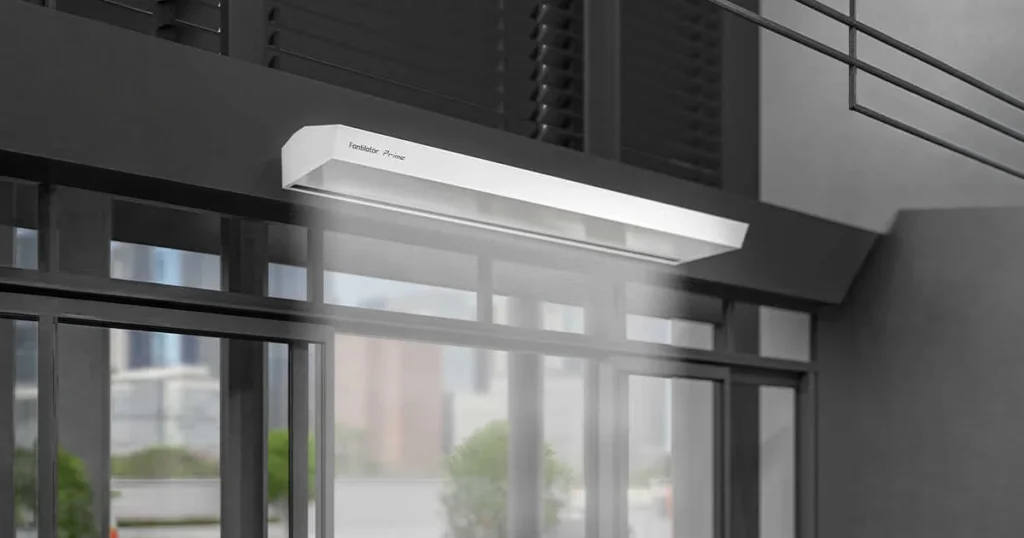
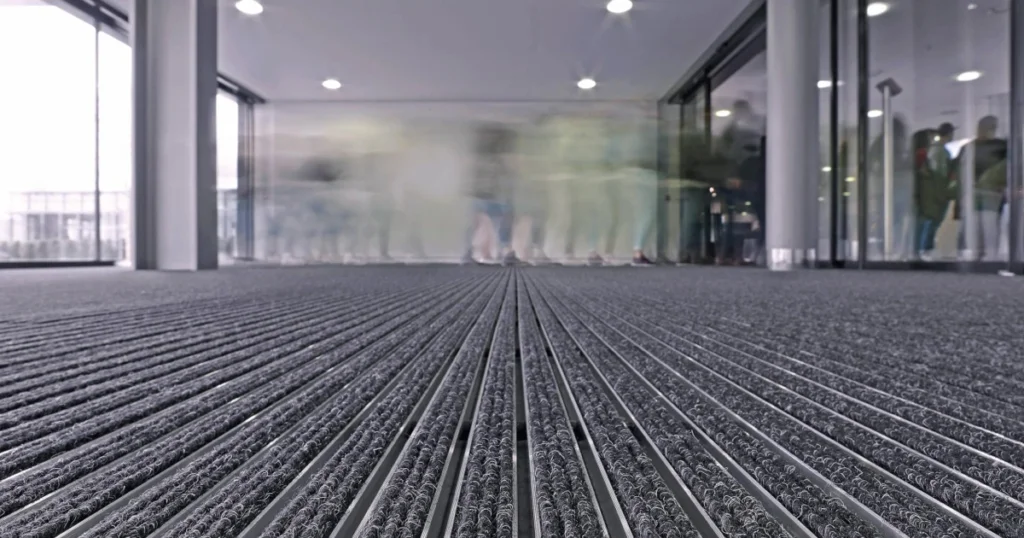
Examples include canopy thermal insulation, air curtains, entrance matting, night shields, specialised floor rings and compatible model-specific components.
An air curtain, for example, can be considered where additional airflow management is required near the entrance.
However, not every revolving door needs an air curtain. The decision should be based on building pressure, climate, wind exposure and actual operating conditions.
Aluminum entrance matting is another consideration. Its size, insert type and recessed floor arrangement can influence the associated project cost.
Night shields and other entrance features may be relevant to the building’s security or after-hours operating requirements.
The most economical specification is not necessarily the one with the fewest features or the one with every option installed.
It is the configuration that provides the required functions without unnecessary equipment.
Thermal upgrades should also be evaluated realistically. An air curtain or insulated component does not guarantee a fixed percentage of energy savings across different buildings.
7. Installation, Transport and After-Sales Services
The quoted product price and the final installed project cost are not always the same.
Transport, site access, lifting equipment, structural preparation, electrical connections, assembly and commissioning may influence the total amount.
For example, an entrance in a newly constructed building with completed structural interfaces may be easier to coordinate than a refurbishment project in an operating hotel.
An existing entrance may require removal work, floor alterations or installation activities outside normal building hours.
Large-diameter revolving doors may also require additional transport and lifting arrangements.
For international projects, shipping methods, customs procedures, delivery terms and local installation services can introduce further cost differences.
After-sales services should be evaluated as part of the quotation.
Warranty conditions, maintenance arrangements, spare parts availability and service response responsibilities can all affect long-term ownership.
A lower initial quotation may not provide the best overall value if essential installation or maintenance services are excluded.
How Should Automatic Revolving Door Quotations Be Compared?
A meaningful price comparison requires equivalent technical specifications.
Two quotations for revolving doors of the same diameter may include different glazing, surface finishes, controllers and safety devices.
One supplier may include installation and commissioning, while another provides an equipment-only price.
Without clarifying these differences, the lower quotation may appear more attractive even though it covers fewer services.
A comparable quotation should identify the door model and dimensions, wing arrangement, glazing and finish, motor and controller, safety equipment, optional accessories, delivery conditions, installation scope and warranty.
Any exclusions should also be stated clearly.
For international purchases, the quotation currency, applicable taxes and agreed delivery terms should be reviewed alongside the product price.
This approach helps distinguish genuine price differences from differences in the technical or commercial scope.
Is the Initial Price or Total Cost of Ownership More Important?
Initial purchase cost is important, but it does not represent the full financial impact of an automatic revolving door.
Long-term considerations may include electricity consumption, scheduled maintenance, replacement components and servicing requirements.
Entrance-related air exchange may also influence a building’s heating and cooling demand.
However, the financial benefit depends on local climate, operating hours, pedestrian traffic and the complete entrance arrangement.
A reliable cost assessment should not assume that every revolving door installation produces the same energy savings.
Instead, decision-makers should compare initial investment with the expected operating requirements and maintenance commitments.
A suitable revolving door is one that provides the required functionality, safety and architectural performance at a sustainable overall cost.
How to Request an Automatic Revolving Door Price from Adezza
Adezza offers automatic revolving door solutions for commercial and architectural projects with different entrance requirements.
The ADZ303 range provides conventional automatic revolving-door configurations. The ADZ503 Vista and ADZ603 Combo series address larger or more specialised entrance applications.
Identifying the appropriate model is an important first step towards obtaining a relevant quotation.
Providing entrance dimensions, architectural drawings, expected pedestrian traffic, glazing preferences, required finishes and safety equipment helps establish the technical scope.
Installation location, delivery requirements and any special building conditions should also be included.
Explore Adezza’s revolving door products and request an automatic revolving door quotation based on your project requirements.